 Talk
What a rate limit is rationing
A rate limit is presented as plumbing and behaves like a price. Every vendor explains it the same way, in the language of fairness and abuse prevention, and then publishes a ladder you climb by spending money.
On one of the three pages we read on October 20, 2026, the ration is denominated in dollars rather than tokens. On another, the numbers are printed in full and labelled as ceilings rather than promises. On the third they are not printed at all.
This essay is about what you are actually buying when a vendor raises your limit, and about the one limit that tells you not to retry.
Google rations in dollars per ten minutes
The clearest evidence that a rate limit is a commercial instrument sits on the Gemini API rate limits page, in a table whose unit is money.
Under the heading Spend-based rate limits, the page states that the API "enforces spend-based rate limits to protect against unexpected charges" and that these "are evaluated on a rolling 10-minute window".
The table reads: Free, N/A. Tier 1, $10. Tier 2, $50. Tier 3, $200. That is the maximum you may spend per ten minutes, checked October 20, 2026.
A second table on the same page sets a Billing tier cap of $250 for Tier 1, $2,000 for Tier 2 and "$20,000 - $100,000+" for Tier 3. The ladder is drawn in dollars from top to bottom.
When you cross the spend line the API returns "a 429 RESOURCE_EXHAUSTED error", and the page's own first suggestion is to "Reduce the rate of expensive requests, for example by using smaller context windows or shorter outputs".
Read that advice carefully. It is a throttle on the cost of a request, not on the number of them. The quota and the invoice are the same object.
The tiers are a spend ladder, and the pages say so
OpenAI's rate limits guide lists three paid tiers and qualifies them by purchase: Build at "$5 in total credit purchases", Launch at "$100", Grow at "$500". The matching monthly usage limits are $500, $5,000 and $200,000, against $100 a month on Free.
Google's qualification column is blunter still. Tier 2 reads "Paid $100 + 3 days from first successful payment" and Tier 3 reads "Paid $1,000 + 30 days from first successful payment".
Anthropic places organisations on a tier "automatically based on usage history and account standing" and adds that new organisations "may start in the Evaluation tier, with limits below the standard limits shown on this page while account history is established".
Printing the numbers is a choice, and one vendor declines
Anthropic publishes full tables. On the Start tier, Claude Sonnet 5.5 is listed at 1,000 requests per minute, 2,000,000 input tokens per minute and 400,000 output tokens per minute.
The Build tier lists 5,000, 5,000,000 and 1,000,000 for the same model, and the Scale tier 10,000, 10,000,000 and 2,000,000.
OpenAI publishes a shorter table: on Build, the Astra, Sol and Terra models are listed at 5,000 RPM and 1,000,000 TPM, rising on Grow to 15,000 RPM and 40,000,000 TPM, with Luna at 30,000 and 180,000,000.
Google prints neither. The section headed Gemini API rate limits says only that limits "depend on a variety of factors (such as your usage tier) and can be viewed in Google AI Studio".
The sentence that follows is the one worth copying down: "Specified rate limits are not guaranteed and actual capacity may vary."
A ceiling is not a floor, and the page admits it
Anthropic's version of that caveat is more explicit than most vendors manage. "All limits described here represent maximum allowed usage, not guaranteed minimums," the page states.
The same page explains that limits are enforced on shorter intervals than the published unit: "a rate of 60 requests per minute (RPM) might be enforced as 1 request per second. Short bursts of requests can exceed the limit and trigger rate limit errors."
There is also a limit on how fast you may grow into your limit. The page notes 429 errors "because of acceleration limits on the API if your organization has a sharp increase in usage", and advises ramping "gradually".
So the published number is a ceiling, enforced on a timescale finer than the one it is quoted in, and reachable only on a schedule. That is a rationing system described accurately.
One limit tells you not to retry, and it is the money one
The most useful distinction on any of these pages is between the limit that will clear and the limit that will not.
Anthropic lists monthly spend caps of $500 on Start, $1,000 on Build and $200,000 on Scale. When you reach one, requests return a 429 whose error type is the ordinary rate limit type.
The page then closes the trap: "the response has no retry-after header. Retrying, including the SDK's automatic retries, fails until access resumes." The distinguishing field is error_code reading enforced_spend_limit_reached.
A limit you set yourself behaves differently again. That one returns HTTP 400 with an invalid_request_error. OpenAI draws the same line, listing a hard spend limit whose effect is that "Affected API requests return a 429 error".
A retry loop cannot tell the difference without reading the body. An outage that is really an invoice will look like congestion to any client that only checks the status code.
Guaranteed capacity is a contract, where it is sold at all
If a rate limit is rationing, the premium product is a ration coupon, and the market for those has moved.
Anthropic's service tiers page now opens with a notice: "Priority Tier capacity commitments are no longer available for purchase." Existing holders continue to their contract end date, and anyone needing "guaranteed capacity" is pointed at sales.
Google's priority inference carries its own ration: "Default rate limits are: 0.3x the standard rate limit for each model and tier." Priority buys ordering, not room.
OpenAI's Scale Tier is the most legible version. It is "available to Enterprise customers", sold in units per day, and the GPT-5.5 row lists 50,000 tokens per minute at "$750.00 per unit/day".
Each unit is "purchased for a minimum of 30 days". That is not an API price. That is a lease on throughput, which is what a ration coupon looks like when it has a contract attached.
What to ask before you build on somebody else's quota
The useful questions are not about the headline number. They are about the shape of the limit:
- Is the limit in tokens, requests or dollars? Google's spend-based table is in dollars per ten minutes, which throttles expensive calls rather than frequent ones.
- Is the number published or only visible once you sign in? Anthropic prints three full tables; the Gemini page sends you to AI Studio and warns that capacity "may vary".
- Which 429 clears on its own? A rate limit carries retry-after. A spend cap, per Anthropic's page, carries nothing and defeats automatic retries.
- How long does a tier upgrade take? Google's Tier 2 needs three days after the first payment and Tier 3 needs thirty, so a launch cannot buy its way up in an afternoon.
- What does priority actually promise? Google's priority limits start at 0.3x standard, and Anthropic has stopped selling capacity commitments outright.
Why the word limit survives
Calling it a limit is not dishonest. The constraint is real, the hardware is finite, and abusive traffic exists.
What the word hides is that the dial is set per customer, in tiers, by spend, and can be moved on request. A limit your supplier adjusts after a conversation is a term of sale, not a law of physics.
Google says the conversation can go the other way too: an upgrade request "may be denied based on other factors identified during the review process".
What follows in practice
Budget headroom the way you budget price. Take the tier you will actually sit on, read the published number if there is one, and assume the enforced number is lower on a one-second window.
Then decide which failure you are designing for. The arithmetic for small teams sits in our primer on AI assistant pricing for small teams, and the capacity-word problem is the subject of unlimited is a pricing word.
The per-token side of the same bill is in what a context window costs you, and the reason the cheapest tier exists at all is argued in the free tier is a research budget.
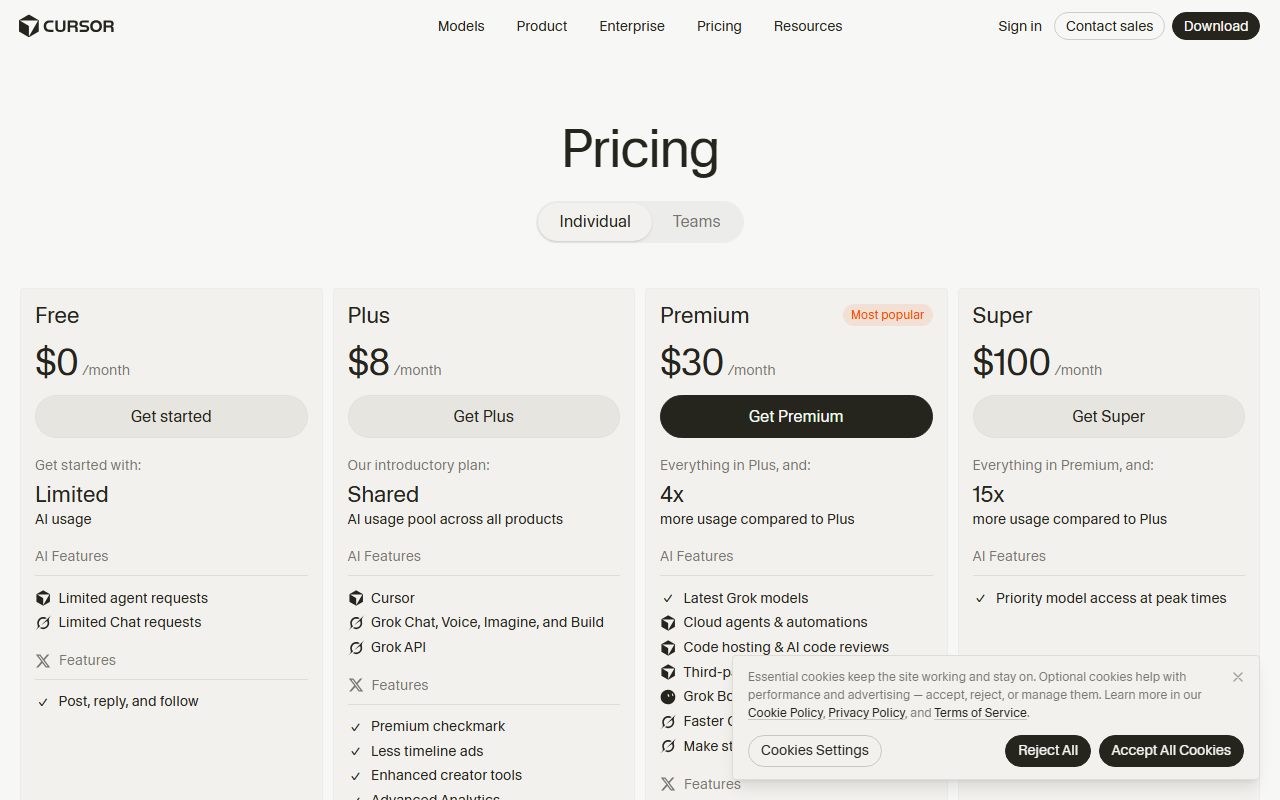
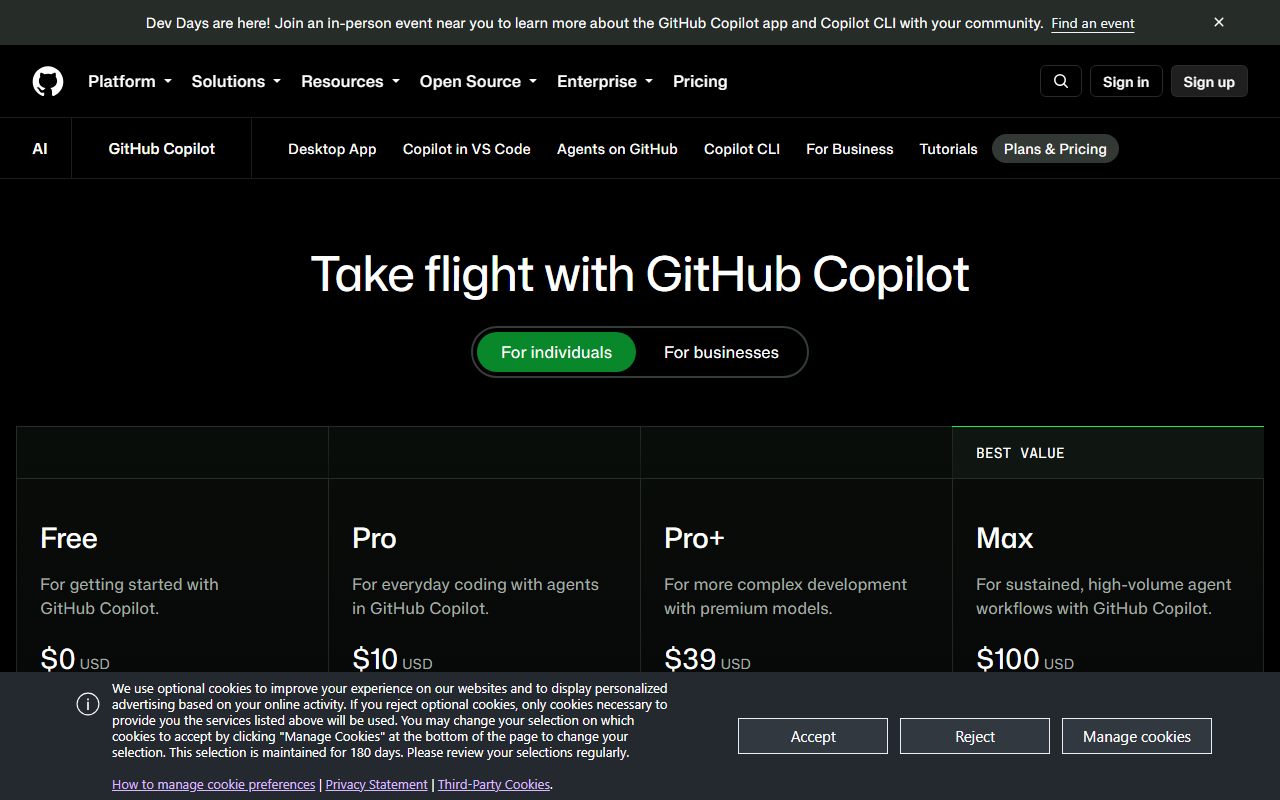
Plan-level detail, with the dates we read it, sits in our subject pages for ChatGPT, Claude, Cursor and GitHub Copilot, and the two consumer plans are set side by side in the ChatGPT and Claude comparison.
A rate limit is the price of going fast, quoted in a unit that is not money and billed in a currency that is. Read it as a price list and it stops being surprising.
Sources, read October 20, 2026: platform.claude.com rate limits and service tiers documentation; developers.openai.com rate limits guide; ai.google.dev Gemini API rate limits; openai.com Scale Tier page.