 Talk
ChatGPT vs Claude: which suits a small team
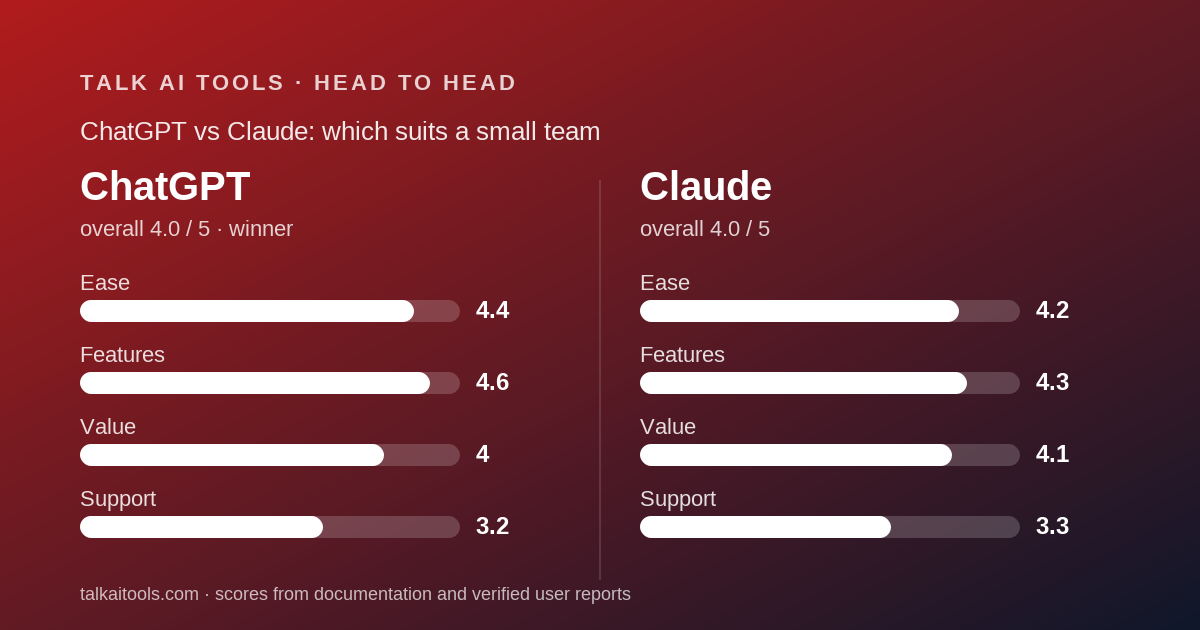
Two views of the same decision. Both vendors sell a small company the same seat at the same price, $20 a month billed annually or $25 monthly from two seats, so the choice is made on everything else: what the free plan meters, who gets an annual term, what the admin can see, and what happens when someone runs out. Built from OpenAI's and Anthropic's own pricing pages, help centers and privacy documents as read on October 10, 2026, not from running either product.
 4.0ChatGPT
 4.0Claude
Specification by specification
| Spec | ChatGPT | Claude |
|---|---|---|
| Entry seat price (company plan) | Business Standard $20/seat/mo annual, $25 monthly | Team Standard $20/seat/mo annual, $25 monthly |
| Heavy-user seat | Premium $100 annual / $125 monthly, 5x usage, no 5-hour limit | Premium $100 annual / $125 monthly, 6.25x Pro per session |
| Seat minimum and ceiling | 2 users; stated range 2 to 200 | 2 members; up to 150 seats |
| Individual plan | Plus $20/mo monthly only; Pro $100, $200, $500 monthly | Pro $17/mo annual ($200 up front) or $20 monthly; Max $100 or $200 monthly |
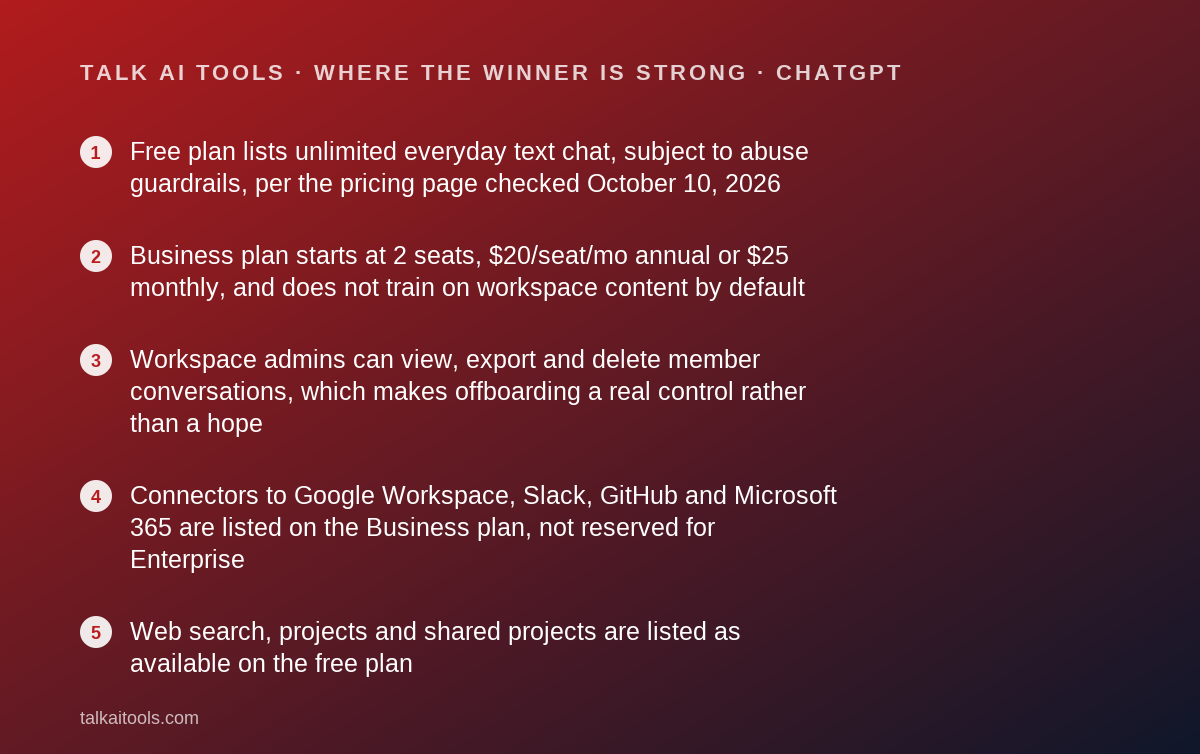
| Free plan | Unlimited everyday text chat subject to abuse guardrails; limited uploads, images, voice | Everyday use on Sonnet and Haiku; 5 projects; no Opus, no Claude Code |
| Training on company data | Off by default on Business and Enterprise | Off by default on Team, Enterprise and API |
| Training on personal plans | On until 'Improve the model for everyone' is turned off | Governed by a privacy setting; labelled opt-out |
| Admin can view and delete member chats | Yes, per enterprise privacy FAQ | Vendor documentation read for this page does not state it |
| Published retention periods | Deleted within 30 days; temporary chats up to 30 days | Deleted within 30 days; incognito 30 days; violations up to 2 years; feedback 5 years |
| Connectors on the entry company plan | Google Workspace, Slack, GitHub, Microsoft 365 | Google Drive, Gmail, Calendar, GitHub, Microsoft 365, Slack |
| SSO on the entry company plan | SAML SSO and MFA | SSO and domain verification |
| Audit logs, SCIM, custom retention | Enterprise only, custom pricing | Enterprise only, $20/seat annual plus usage at API rates |
| Included API credits | None listed | Team up to $500/mo pooled; Max $100 or $200/mo |
| Support below Enterprise | Help center; enhanced support marked No | Help center; customer success only on sales-assisted Enterprise |
The short answer: ChatGPT for breadth and unmetered chat, Claude for terms you can quote
This is a documentation comparison. Every claim comes from the two vendors' pricing pages, help centers and privacy pages as read on October 10, 2026. The full detail sits on the two subject pages, ChatGPT and Claude; this page is about choosing.
The short version:
- ChatGPT is best for a small team where most people will use plain chat, where the admin wants documented power to see and delete staff conversations, and where the widest list of connectors and consumer features matters. Its free plan lists unlimited everyday text chat; Claude's does not.
- Claude is best for a team that works in long documents and code, wants an annual rate on an individual plan, would use pooled API credits, and prefers a vendor that prints its usage model and retention periods as numbers.
- Winner, narrowly: ChatGPT, because for the typical small company the unmetered free tier and the admin's documented controls on Business decide more purchases than annual individual pricing does. The margin is one row of a table, and the next sections show which row.
Price: the two companies charge the same seat, so price decides nothing
Both pricing pages, read on October 10, 2026, list the entry company seat at $20 per month billed annually or $25 billed monthly, from two seats. Both list a heavier seat at $100 annually or $125 monthly. Both allow mixing seat types in one workspace. Ten Standard annual seats cost $2,400 a year at either vendor; that is an editorial calculation from identical listed prices.
The differences are at the edges. OpenAI states Business is for 2 to 200 employees; Anthropic caps Team at 150 seats before Enterprise. OpenAI's Enterprise has no public price; Anthropic's is $20 a seat annually plus usage at API rates, with no included allowance.
If you are choosing on seat price, stop: there is nothing to choose. The primer on AI assistant pricing explains why the headline converged and what still differs underneath it.
Individuals: Claude offers an annual term and ChatGPT does not
For one person the pages diverge. Anthropic lists Pro at $17 a month billed annually, $200 up front, or $20 monthly. OpenAI's help center says annual billing is not supported for Go, Plus or Pro; Plus is $20 a month, Pro is $100, $200 or $500 a month.
Over a year a Claude Pro annual subscriber pays $200 and a ChatGPT Plus subscriber pays $240. That $40 is the only clean price gap between the two vendors on October 10, 2026, and it exists only for individuals.
At the top of the individual ladder the shapes differ too. Claude Max at $100 or $200 includes the same amount in monthly API credits. ChatGPT Pro at $100, $200 or $500 includes no credits but lists an always-on agent and, at $500, Ultrafast models. Neither top tier is a small-team purchase; both are a power user's.
Free plans: ChatGPT meters everything except chat, Claude meters chat too
OpenAI's pricing page lists the free plan as unlimited text chats, subject to abuse guardrails, then marks uploads, images, voice, deep research, memory and Codex as limited. Anthropic's page lists a $0 plan for everyday use with web search, file creation, memory and five projects, on Sonnet and Haiku, with usage resetting on a rolling five-hour window and no Opus or Claude Code.
For a company deciding whether to pay at all, this is the sharpest difference in the comparison. A team of five that only drafts emails and summarises pasted text can, on the documents, run on ChatGPT's free plan indefinitely. The same team on Claude's free plan will meet the five-hour window.
The same documents also say why running a company on free personal accounts is a mistake regardless of vendor: no admin, no offboarding, and training settings left to each individual. The free plan decides a trial, not a purchase. The essay Unlimited is a pricing word is about the first word in OpenAI's sentence.
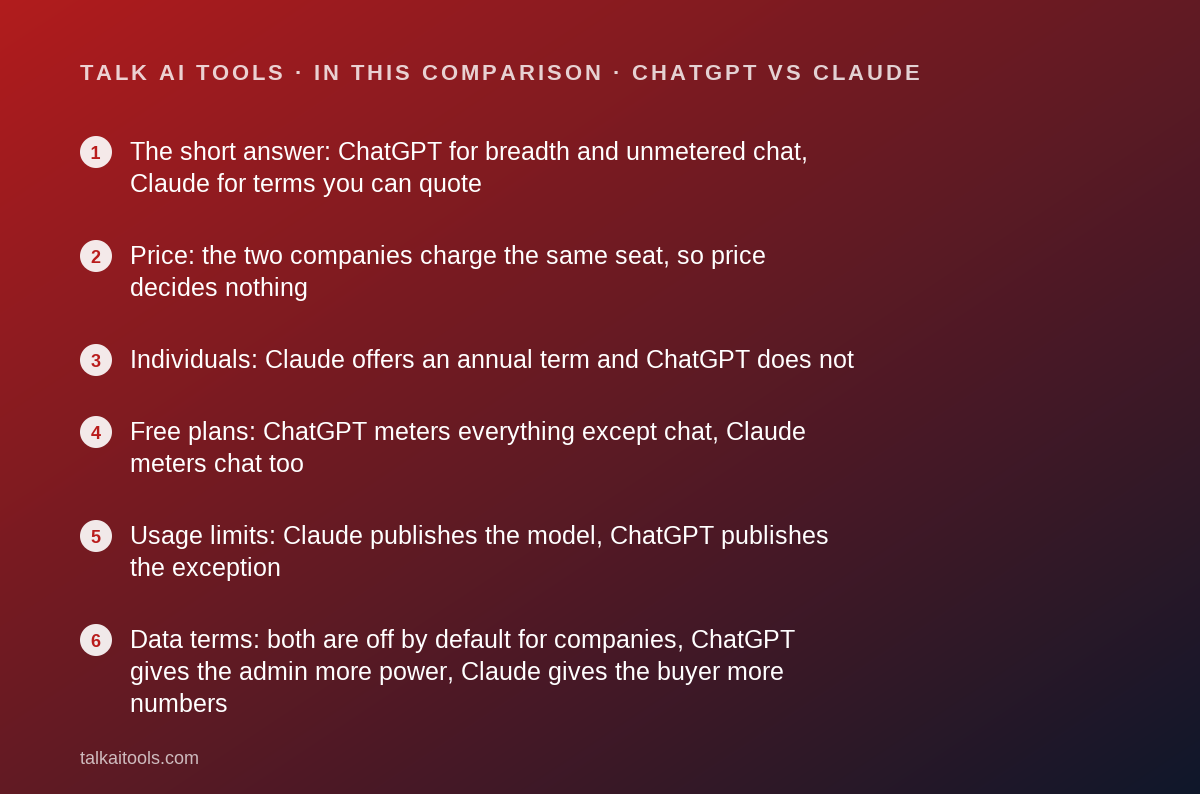
Usage limits: Claude publishes the model, ChatGPT publishes the exception
Anthropic's pricing page states the limit model in full: a rolling five-hour session on every plan, weekly limits on paid plans, one pool across web, desktop, mobile and Claude Code, no fixed message count. The Team help article quantifies seats at 1.25x and 6.25x Pro's per-session allowance, per member. When a limit is hit, a paid user can turn on usage credits at API rates and keep working.
OpenAI's pricing page describes limits by exception. Individual plans say Limited and Expanded; the footnote says usage must be reasonable. The one hard statement is on the business pricing page: a Premium seat has no 5-hour limit, which tells you a Standard seat has one. Business and Enterprise can buy credits; individual plans cannot.
For a small team the practical difference is forecasting. Claude's documents let you reason about how a heavy user will hit the wall and what it will cost to go past it. ChatGPT's documents tell you the wall exists and that the $100 seat removes it. Claude wins this section on candour; whether its limits are more generous is not something documentation can tell you.
Data terms: both are off by default for companies, ChatGPT gives the admin more power, Claude gives the buyer more numbers
On company plans the two vendors say the same thing in different words. OpenAI's data controls article: content from Business, Enterprise and Edu workspaces is not used for training by default. Anthropic's privacy center: inputs and outputs from commercial products are not used by default, unless you submit feedback or otherwise permit it.
On personal plans both default to training with a setting to turn it off. OpenAI's is called Improve the model for everyone; Anthropic's pricing table labels consumer plans opt-out. Neither vendor's personal plan is a sensible place for client documents.
Where they differ is in what else is written down. OpenAI's enterprise privacy FAQ says Business workspace admins can view, access, export and delete member conversations, and that deleted conversations leave its systems within 30 days.
Anthropic's retention page gives a fuller schedule: deletion within 30 days, incognito chats deleted within 30 days, policy-violation content retained up to 2 years, feedback 5 years. The Anthropic documents we read for this page do not state whether a Team admin can read a member's chats.
A buyer who must offboard staff will value OpenAI's stated admin power. A buyer who must fill in a client's security questionnaire will value Anthropic's numbers. The essay Who reads what you type argues the second matters more often than people expect.
Features: ChatGPT lists more, Claude bundles the two that cost extra elsewhere
On breadth, OpenAI's comparison table is longer. Web search, a built-in browser, projects, shared projects, scheduled tasks, Sites, plugins, interactive apps, Skills, voice with video, data analysis, vision, memory with past chats, Codex, and on Business, workspace agents and scheduled team tasks. Most of the consumer list reaches at least Limited on the free plan.
Anthropic's table is shorter and includes two items that are not add-ons: Claude Code and Cowork are on every paid plan and share the plan's usage pool. It also lists projects with sharing, connectors to the main workplace tools, enterprise search across Slack and Microsoft 365, Research, Skills, Design, Slides, Docs, Dashboards, Claude in Chrome and Microsoft 365, and context windows up to 1M tokens on the newest models.
For a team whose work is mostly conversation and light automation, ChatGPT's list is the better fit. For a team whose work is long documents and code, Claude's bundle is the better fit. A documentation comparison can count the lists; it cannot tell you which items you will use, and most teams use five.
Admin and compliance: both stop at the same line, and the line is Enterprise
On the entry company plan the two are close. ChatGPT Business lists SAML SSO, MFA, central billing, usage analytics, spend controls and an admin console. Claude Team lists SSO, domain verification, central billing, usage analytics, spend controls, connector admin controls and organisation-wide skills deployment.
Both hold back the same set for Enterprise: SCIM, audit logs, custom data retention and HIPAA configurations. Anthropic's table also marks role-based access as No on Team, although its help article lists role-based permissioning as included; we grade the table and note the conflict. OpenAI lists data residency in ten regions and customer-managed keys under Enterprise.
Payment terms differ in a way small finance teams will notice. Claude Team is credit card only; invoicing and net terms appear only for sales-assisted Enterprise. OpenAI's pricing FAQ says Business can be bought with any major card and that invoicing is an Enterprise conversation. Neither vendor will send a $2,400 invoice to a small company without a sales call.
Support: neither documents a person to call below Enterprise
OpenAI's comparison table marks Enhanced support, Dedicated onboarding and Ongoing account management as No on every individual plan, and its business page lists 24/7 priority support and SLAs only under Enterprise. Anthropic's partnership table lists consultation, trials and customer success support only for sales-assisted Enterprise.
What a paying small team gets from either vendor is a help center and in-product support. Both help centers are current and dated to within days on the articles we read, which is worth something. But neither pricing page promises a Team or Business customer a channel, a response time or a human. This section is a tie, and not a flattering one.
What users report
This comparison does not quote third-party review aggregators. Their averages pool developers, students and enterprises with the small teams this site writes for, and the result describes no one. When a future edition cites user reports, they will be named, dated and about the Business and Team plans specifically. Until then the evidence is the vendors' documentation, read the same day for both.
Switching: the data moves, the habits do not
Both vendors document export. OpenAI's data controls article says individual users can export from settings, while Business and Enterprise export goes through the workspace owner. Anthropic's privacy pages describe deletion in detail and point to export for commercial customers through the organisation.
What neither page can promise is that a team which has built projects, custom instructions and scheduled tasks in one product will move them to the other without rebuilding. The projects export; the way of working does not. We make that argument at length in The claim that you can always switch, and it applies here with unusual force because the two products are converging on price and diverging on shape.
Choose ChatGPT if
- Most of the team will use plain chat, which the free plan lists as unlimited subject to abuse guardrails and the Business plan does not meter beyond the 5-hour session.
- You need the admin's power to view, export and delete staff conversations written down, as OpenAI's enterprise privacy FAQ does.
- You want the longest feature list on a $20 seat, including workspace agents and scheduled team tasks on Business.
- Your heavy users can be counted on one hand and you will put them on $100 Premium seats without the 5-hour limit.
Choose Claude if
- You pay annually as an individual and want the $17 rate, the only individual annual term in this comparison.
- Your work is long documents and code, where Claude Code, Cowork and 1M-token context windows are included rather than extra.
- You must answer a client's security questionnaire and want retention periods in days and years rather than assurances.
- Pooled API credits would offset spending you already have; Team lists up to $500 a month and Max $100 or $200.
Frequently asked
- Which is cheaper for a 10-person team? Neither. Both list $20 a seat billed annually or $25 monthly from two seats, so ten Standard seats are $2,400 a year at either vendor (editorial calculation, pricing pages checked October 10, 2026). The gap appears only for individuals, where Claude Pro's annual rate saves $40 a year over ChatGPT Plus.
- Can I switch from ChatGPT to Claude and keep my data? Both vendors document export; on company plans it goes through the workspace owner or organisation. Chats and files move; projects, custom instructions and scheduled tasks have to be rebuilt in the other product's terms.
- Which one trains on my team's data? Neither, by default, on Business or Team. Both train by default on personal plans until the user turns the setting off, which is the strongest argument for buying the company plan from either vendor.
- Which has the better free plan for a business? ChatGPT lists unlimited everyday text chat subject to abuse guardrails; Claude's free plan is a sampler on a five-hour window without Claude Code. For a trial, ChatGPT's is more usable; neither is a business plan.
- Do either include support? Not as a documented channel below Enterprise. Both offer a help center and in-product support on the $20 seat; named support, onboarding and SLAs appear only on Enterprise pages.
Bottom line
Price is a tie by design. ChatGPT wins the comparison for the typical small company on two documented facts: an unmetered free tier for the people who will only ever chat, and an admin with stated power to see and delete what staff leave behind. Claude wins for the team whose work is documents and code, who will pay annually, and who want a vendor that prints its limits and retention as numbers.
Whichever you pick, buy the company plan and not a pile of personal ones; both vendors' documents make the reason plain. Then read What a seat means when the worker is software before the renewal, because the $20 seat on both pages is a floor, and both vendors have already built the $100 one above it.
Subject pages: ChatGPT and Claude. Pricing arithmetic for both: the primer. All sources checked October 10, 2026: openai.com/chatgpt/pricing, openai.com/business/pricing, openai.com/enterprise-privacy, OpenAI help center (Plus, Pro tiers, Go, data controls, Business release notes); claude.com/pricing, Claude help center (Team plan, Enterprise plan, usage limits), Anthropic privacy center (retention, model training).
Frequently asked
Which is cheaper for a 10-person team, ChatGPT or Claude?
Neither. Both list $20 a seat billed annually or $25 monthly from two seats, so ten Standard seats cost $2,400 a year at either vendor, an editorial calculation from pricing pages checked October 10, 2026. The gap is for individuals: Claude Pro annual saves $40 a year over ChatGPT Plus.
Can I switch from ChatGPT to Claude and keep my data?
Both vendors document export; on company plans it goes through the workspace owner or organisation. Chats and files move. Projects, custom instructions and scheduled tasks must be rebuilt in the other product's terms, which is the real switching cost.
Does ChatGPT or Claude train on my team's data?
Neither does by default on Business or Team, per OpenAI's data controls article and Anthropic's privacy center, both checked October 10, 2026. Both train by default on personal plans until the user turns the setting off.
Which has the better free plan for a business?
ChatGPT lists unlimited everyday text chat subject to abuse guardrails. Claude's free plan runs on Sonnet and Haiku with a five-hour window and no Claude Code. For a trial, ChatGPT's is more usable; neither is a business plan, since neither has an admin.
Do ChatGPT Business or Claude Team include support?
Not as a documented channel. Both offer a help center and in-product support on the $20 seat. Enhanced support, onboarding and SLAs appear only on Enterprise pages for both vendors, per the pricing pages checked October 10, 2026.
Visit ChatGPT
We have no affiliate relationship with this vendor. Link goes to the official site.
Visit Claude
We have no affiliate relationship with this vendor. Link goes to the official site.