 Talk
A primer on AI assistant pricing for small teams
Our top pick for a small team buying its first AI assistant is ChatGPT Business, because its free tier lets you trial the habit before paying and its admin controls are documented; Claude Team is the pick for teams that work in documents and code and want an annual individual rate. This primer is for the person who signs the card: it explains the plan ladders both vendors publish, the arithmetic for two, ten and twenty people, and the four lines of fine print that move the bill. Grades come from pricing pages, help centers and privacy documents checked October 10, 2026, not from running either product.
The picks at a glance
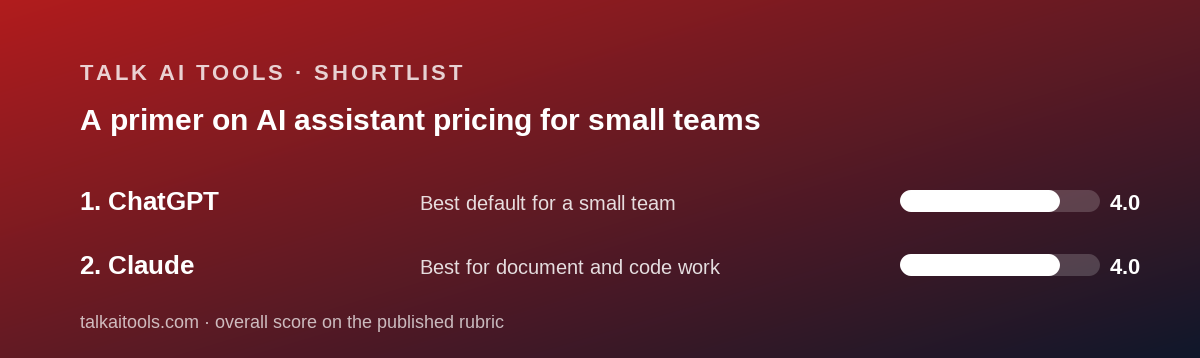
Two assistants are graded in this cluster, and both are worth buying for the right team. The table below is the whole primer in one place; the rest of the page explains each row.
- Best default for a small team: ChatGPT - Business Standard $20/seat/mo billed annually, $25 monthly, 2 to 200 seats; free plan lists unlimited everyday text chat; training off by default on Business; admins can view and delete member chats. Overall 4.1 on our rubric. Subject page.
- Best for document and code work, and for annual individuals: Claude - Team Standard $20/seat/mo billed annually, $25 monthly, 2 to 150 seats; Pro $17/mo annual; Claude Code and Cowork included; up to $500/mo pooled API credits on Team; retention periods published. Overall 4.0 on our rubric. Subject page.
- Head to head: ChatGPT vs Claude, decided on everything except price, because the price is the same.

How we graded, and what we did not do
We did not run either product for this primer; grades come from documentation, pricing pages and vendor statements checked on October 10, 2026. Four criteria carry the score, each weighted equally.
- Ease: how short the plan ladder is, whether the entry company plan is self-serve, and whether the vendor explains its own limits without footnotes.
- Features: what is listed on the $20 company seat, and what is held back for Enterprise.
- Value: the seat price, the annual discount, included credits, and how far the heavy-user seat sits above the headline.
- Support: whether any channel, hours or response time are documented below Enterprise. Both vendors score poorly here, and the primer says so.
Where a vendor's own documents disagree with each other, we grade the more recent and specific page and note the conflict. Where a figure is not published, we write that it is not published rather than estimating.
Start by reading the right half of the pricing page
Both vendors split their pricing page into individual plans and company plans, and most small teams read the wrong half. The individual half is where the famous numbers live: $20 a month for ChatGPT Plus, $17 or $20 for Claude Pro. The company half is where a business should be looking, and on October 10, 2026 it reads almost identically at both vendors.
ChatGPT Business and Claude Team both list a Standard seat at $20 per month billed annually or $25 billed monthly, a Premium seat at $100 annually or $125 monthly, a two-seat minimum, and the right to mix seat types. OpenAI states a range of 2 to 200 employees; Anthropic caps Team at 150 seats.
The reason to read this half is not price, since it is the same. It is that the company plan is the one with an administrator, central billing, SSO, and training turned off by default. Eight people on personal plans are eight customers with eight privacy settings. Eight people on a company plan are one customer with one console.
The arithmetic for two, ten and twenty people
These are editorial calculations from the listed prices on both pricing pages, checked October 10, 2026. They are the same at both vendors because the seat prices are the same.
- Two people, Standard, annual: 2 x $20 x 12 = $480 a year. Monthly: 2 x $25 = $50 a month, $600 a year.
- Ten people, Standard, annual: 10 x $20 x 12 = $2,400 a year. Monthly: $250 a month, $3,000 a year.
- Ten people with two on Premium, annual: (8 x $20 + 2 x $100) x 12 = $4,320 a year. The two heavy users cost as much as the other eight combined.
- Twenty people, Standard, annual: 20 x $20 x 12 = $4,800 a year. Monthly: $500 a month, $6,000 a year.
- Twenty people with four on Premium, annual: (16 x $20 + 4 x $100) x 12 = $8,640 a year.
Two things follow. Annual billing is listed 20 per cent below monthly at both vendors, so the only reason to pay monthly is uncertainty about headcount, which both vendors address by letting you add seats mid-term. And the Premium seat is the number that moves the bill: one heavy user costs five Standard users.
Line one of the fine print: what the Standard seat does not include
On OpenAI's business pricing page the Premium seat is described as five times the usage of Standard, with no 5-hour limit. That sentence tells you the Standard seat has a 5-hour limit, which the page does not otherwise state. Business and Enterprise workspaces can buy credits for more access; individuals cannot.
On Anthropic's pages the limit model is explicit. Every plan resets on a rolling five-hour session; paid plans add a weekly limit; a Team Standard seat has 1.25 times Pro's per-session allowance and Premium has 6.25 times, per member. A paid user who hits the wall can turn on usage credits at standard API rates.
Neither vendor publishes a message count, and both say so. What you can do is plan for the shape: a short session window that most people will never notice and two or three people who will notice it weekly. The ChatGPT subject page and the Claude subject page quote the exact wording from each vendor.
Line two: the free plan is a trial, not a tier
OpenAI's pricing page lists the free plan as unlimited text chats with GPT-6, subject to abuse guardrails, and marks uploads, images, voice, deep research, memory and Codex as limited. Anthropic's lists a $0 plan for everyday use on Sonnet and Haiku, with five projects, no Opus and no Claude Code.
For a trial, ChatGPT's free plan is the more usable, and it is a fair way to discover whether your team will form the habit before paying. But a free personal account has no admin, no offboarding, and a training setting that defaults to on until the user turns it off. That is true at both vendors.
So the free plan answers one question, whether anyone will use the thing, and should not be asked a second. We have written about what the word unlimited is doing on that page in Unlimited is a pricing word.
Line three: training defaults and who can read the chats
On company plans both vendors turn training off by default. OpenAI's data controls article says Business, Enterprise and Edu content is not used to train by default. Anthropic's privacy center says inputs and outputs from commercial products are not used by default unless you submit feedback or otherwise permit it.
On personal plans both default to training with a switch to turn it off: OpenAI calls it Improve the model for everyone; Anthropic's pricing table labels consumer plans opt-out. This is the single strongest reason to buy the company plan rather than reimburse personal subscriptions.
The vendors then diverge in what else they write down. OpenAI's enterprise privacy FAQ states that Business admins can view, access, export and delete member conversations, and that deleted conversations leave its systems within 30 days. Anthropic's retention page gives a schedule: deletion within 30 days, incognito chats within 30 days, policy violations up to 2 years, feedback 5 years. The Anthropic pages we read do not state whether a Team admin can read members' chats.
If you offboard people, OpenAI's stated admin power is the useful sentence. If you answer client security questionnaires, Anthropic's numbers are. The essay Who reads what you type is the long version of this section.
Line four: what Enterprise keeps, and what it costs to find out
Both vendors hold the same set back for Enterprise: SCIM, audit logs, custom data retention and HIPAA configurations. OpenAI adds data residency in ten regions and customer-managed keys; Anthropic adds a compliance API, US-only inference and customer-managed keys. Anthropic's table also marks role-based access as No on Team, though its help article lists it as included; we grade the table.
The cost of finding out differs. OpenAI's Enterprise has no public price; the page says contact sales, and the help center describes credit-based and token-based billing. Anthropic's Enterprise is $20 a seat billed annually plus usage at API rates, with no included allowance and admin-set spend caps, and can be bought self-serve.
For a team under fifty people the honest reading is that Enterprise is a different product with a different buyer. If a client contract requires audit logs, you need it; if not, the Standard and Premium seats are the whole decision.
The individual exception: where the vendors actually differ on price
The only clean price gap on October 10, 2026 is for one person. Anthropic lists Claude Pro at $17 a month billed annually, $200 up front, or $20 monthly. OpenAI's help center says annual billing is not supported for ChatGPT Go, Plus or Pro; Plus is $20 a month. Over a year that is $200 against $240.
Above that the shapes diverge rather than the prices. Claude Max is $100 or $200 a month, monthly only, with the same amount in monthly API credits. ChatGPT Pro is $100, $200 or $500 a month with no credits, an always-on agent, and Ultrafast models at the top tier. These are power-user purchases; a small team should not be budgeting them.
ChatGPT Go sits below Plus. Its help article says the plan may include ads and points to the pricing page for the price, which loads by region at runtime; our fetch did not return a USD figure, so this primer does not print one.
Best default for a small team: ChatGPT
ChatGPT sits first because, on the documents, it answers the two questions a small company asks first. Will people use it? The free plan lists unlimited everyday text chat, so the habit can form before any card is entered. Can we control it? The Business plan documents SAML SSO, MFA, central billing, spend controls, training off by default, and an admin who can view, export and delete member conversations.
Its Business plan lists connectors to Google Workspace, Slack, GitHub and Microsoft 365, workspace agents, scheduled team tasks and shared Pages, which is the longest list on a $20 seat we have read. The weaknesses are no annual term for individuals, no documented support below Enterprise, and a usage model described mostly by exception.
Why it sits at number one: for the typical small company, where most staff will chat and two will do heavy work, the unmetered free tier and the stated admin controls decide more purchases than annual individual pricing does. The margin over Claude is narrow and is argued row by row in ChatGPT vs Claude. Read the full ChatGPT subject page for the sources.
Best for document and code work: Claude
Claude sits second by a small margin and first for a specific team. Its Team plan lists the same $20 and $100 seats, adds Claude Code and Cowork on every paid plan sharing one usage pool, connectors to Google Drive, Gmail, Calendar, GitHub, Microsoft 365 and Slack, enterprise search, and up to $500 a month in pooled API credits.
Its documents are the most candid in the category: the limit model is stated in sentences, the seat multipliers are numbers, and the retention page reads like a schedule. Pro's $17 annual rate is the only individual annual term in the cluster. The weaknesses are a free plan without Claude Code or Opus, no audit logs or SCIM on Team, credit card only, and no documented support channel.
Why it sits at number two: the free plan is a sampler rather than a trial of the real product, and the admin's power over members' chats is not stated on the pages we read. For a team whose work is long documents and code, swap the order. Read the full Claude subject page for the sources.
Also considered
This cluster grades two assistants because they are the two a small company is most likely to already be paying for on personal cards. Other assistants exist, including those bundled into office suites, and will be graded in later clusters on the same rubric. We do not rank what we have not read, and we have not read their pricing pages with the same care yet.
How to choose: five questions to answer before the card
- How many of us will only chat? If the answer is most, ChatGPT's unmetered free tier is a real trial and its Standard seat will rarely be noticed.
- How many of us are heavy users? Each one is a $100 Premium seat at either vendor. If it is more than a fifth of the team, the budget is not $20 a head.
- Do we offboard people? OpenAI documents an admin's power to view, export and delete member chats. Ask Anthropic the same question before buying if it matters to you.
- Do clients send security questionnaires? Anthropic's retention page gives numbers you can paste in. OpenAI's gives the 30-day deletion figure and SOC 2 Type 2.
- Will we pay annually? Both company plans discount 20 per cent for it. For a sole trader, only Claude offers it at all.
Frequently asked
- How much does an AI assistant cost for a small team? On October 10, 2026, both ChatGPT Business and Claude Team list $20 per seat per month billed annually or $25 monthly, from two seats. Ten people on Standard annual seats is $2,400 a year at either vendor, an editorial calculation; heavy users on $100 Premium seats raise it quickly.
- Is it cheaper to reimburse personal subscriptions? Per head it is the same $20, but personal plans train on content by default until each user opts out, have no admin, and cannot be offboarded. Both vendors' documents make the company plan the defensible choice at the same price.
- What is a Premium seat? At both vendors it is the heavy-user seat at $100 a month billed annually or $125 monthly. OpenAI describes it as five times Standard usage with no 5-hour limit; Anthropic describes it as 6.25 times Pro's per-session allowance.
- Do either offer annual discounts? Both company plans list $20 annual against $25 monthly. For individuals, Claude Pro is $17 a month annually; OpenAI says annual billing is not available for Go, Plus or Pro.
- Which one is better? For the typical small team, ChatGPT by a narrow margin on its free tier and documented admin controls. For teams in documents and code, Claude. The comparison argues it section by section.
- Will these prices change? Yes. OpenAI's Business release notes record a USD 5 a month reduction at one point; Anthropic's page says prices are subject to change at its discretion. Every figure on this site carries the date it was read.
Bottom line
Buy the company plan, not a pile of personal ones. Pay annually unless headcount is genuinely uncertain. Count the heavy users before you count the seats, because each one is five seats. And read the other vendor's page the same afternoon, because on October 10, 2026 the two prices are the same and the differences are all in the sentences around them.
If the sentences around the price seem to be getting longer every year, that is not your imagination. The essay What a seat means when the worker is software is about why, and the essay The claim that you can always switch is about what to do before you believe either vendor's answer.
Sources
All checked October 10, 2026. OpenAI: ChatGPT pricing page (openai.com/chatgpt/pricing), business pricing page (openai.com/business/pricing), enterprise privacy page (openai.com/enterprise-privacy), help center articles What is ChatGPT Plus, About ChatGPT Pro tiers, What is ChatGPT Go, Data controls in ChatGPT, ChatGPT Business release notes. Anthropic: Claude pricing page (claude.com/pricing), help center articles What is the Team plan, What is the Enterprise plan, How do usage and length limits work, privacy center articles on retention and model training.
Best default for a small team: ChatGPT
ChatGPT Business lists a Standard seat at $20 a month billed annually or $25 monthly, a Premium seat at $100 or $125 with no 5-hour limit, a two-seat minimum and a 2 to 200 range, per the business pricing page checked October 10, 2026. Training on workspace content is off by default, admins can view, export and delete member conversations, and the plan lists SAML SSO, MFA, spend controls, and connectors to Google Workspace, Slack, GitHub and Microsoft 365. The free plan lists unlimited everyday text chat subject to abuse guardrails, which makes it a usable trial. Held against it: no annual term for individuals, no documented support below Enterprise, and limits described mostly by exception.
For the typical small team the unmetered free tier and the documented admin controls decide more purchases than annual individual pricing does; the margin over Claude is one row of the comparison table.
Visit ChatGPT
We have no affiliate relationship with this vendor. Link goes to the official site.
Best for document and code work: Claude
Claude Team lists the same Standard seat at $20 a month billed annually or $25 monthly and the same Premium seat at $100 or $125, from two members up to 150 seats, per the pricing page and Team help article checked October 10, 2026. Every paid plan includes Claude Code and Cowork on one usage pool, and Team adds SSO, domain verification, spend controls, enterprise search, connectors to Google Drive, Gmail, Calendar, GitHub, Microsoft 365 and Slack, and up to $500 a month in pooled API credits. Pro is $17 a month billed annually, the only individual annual term in this cluster, and the privacy center publishes retention as a schedule. Held against it: a free plan without Claude Code or Opus, no audit logs or SCIM on Team, card-only billing, and no documented support channel.
The free plan is a sampler rather than a trial of the paid product, and the admin's power over members' chats is not stated on the pages we read; for a team whose work is long documents and code, the order flips.
Visit Claude
We have no affiliate relationship with this vendor. Link goes to the official site.
How we chose
We did not run either product for this primer; grades come from documentation, pricing pages and vendor statements checked on October 10, 2026. Four criteria weigh equally: ease (plan ladder length, self-serve company plan, limits explained in sentences), features (what is listed on the $20 company seat), value (seat price, annual discount, included credits, distance to the heavy-user seat) and support (any documented channel below Enterprise). Where a vendor's documents disagree we grade the more recent and specific page and note the conflict. Where a figure is unpublished we say so rather than estimate.
Frequently asked
How much does an AI assistant cost for a small team?
On October 10, 2026 both ChatGPT Business and Claude Team list $20 per seat per month billed annually or $25 monthly, from two seats. Ten people on Standard annual seats is $2,400 a year at either vendor, an editorial calculation from the pricing pages. Heavy users on $100 Premium seats raise the figure quickly.
Is it cheaper to reimburse personal ChatGPT or Claude subscriptions?
Per head it is the same $20, but personal plans train on content by default until each user opts out, have no admin and cannot be offboarded. At the same price, both vendors' own documents make the company plan the defensible choice.
What is a Premium seat on ChatGPT Business or Claude Team?
The heavy-user seat at $100 a month billed annually or $125 monthly at both vendors. OpenAI describes it as five times Standard usage with no 5-hour limit; Anthropic describes it as 6.25 times Pro's per-session allowance, per member. Both let a workspace mix seat types.
Do ChatGPT or Claude offer annual discounts?
Both company plans list $20 annual against $25 monthly, a 20 per cent difference. For individuals, Claude Pro is $17 a month billed annually as $200 up front; OpenAI's help center says annual billing is not available for Go, Plus or Pro.
Which AI assistant is better for a small business, ChatGPT or Claude?
For the typical small team, ChatGPT by a narrow margin, on its unmetered free tier and documented admin controls. For teams whose work is long documents and code, Claude, on included Claude Code, pooled API credits and published retention. Price does not separate them.
Will AI assistant prices change?
Yes. OpenAI's Business release notes record a USD 5 a month reduction to subscription seats, and Anthropic's pricing page says prices are subject to change at its discretion. Every figure on this site carries the date it was read, October 10, 2026 for this primer.