 Talk

Claude
An assistant whose pricing page is unusually frank about limits, sold to small teams on the same $20 seat as its rival.
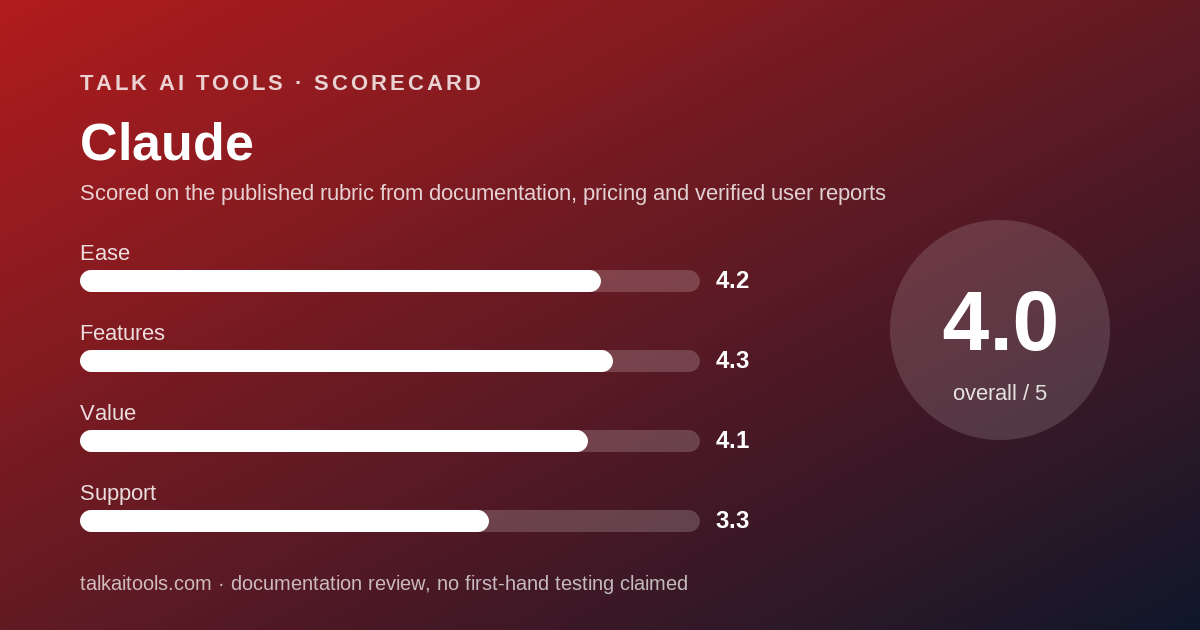
Scored on the published rubric, from documentation, pricing and verified user reports.
Best for: Small teams that work in long documents and code, want commercial data terms that are off by default, and prefer a vendor that publishes its usage model.
Verdict
Claude is the assistant for a small company that would rather know the rules than be told there are none. This is a documentation review: everything here comes from Anthropic's pricing page, its Team plan help article, its usage-limits article and its privacy center as read on October 10, 2026, not from running the product. On those pages Claude's strongest card is candour. The pricing page says there is no fixed message count, explains the rolling five-hour session and the weekly limit, and prices Team Standard seats at $20 a month billed annually or $25 monthly from two seats, with Premium seats at $100 or $125. Commercial plans are not used for training by default, and the retention page gives real numbers. The weaknesses are a free plan that is a sampler rather than a workspace, a Team plan that stops short of audit logs and SCIM, and a support story that amounts to the help center unless you are a sales-assisted Enterprise customer.
Visit Claude
We have no affiliate relationship with this vendor. Link goes to the official site.
Where it is strong
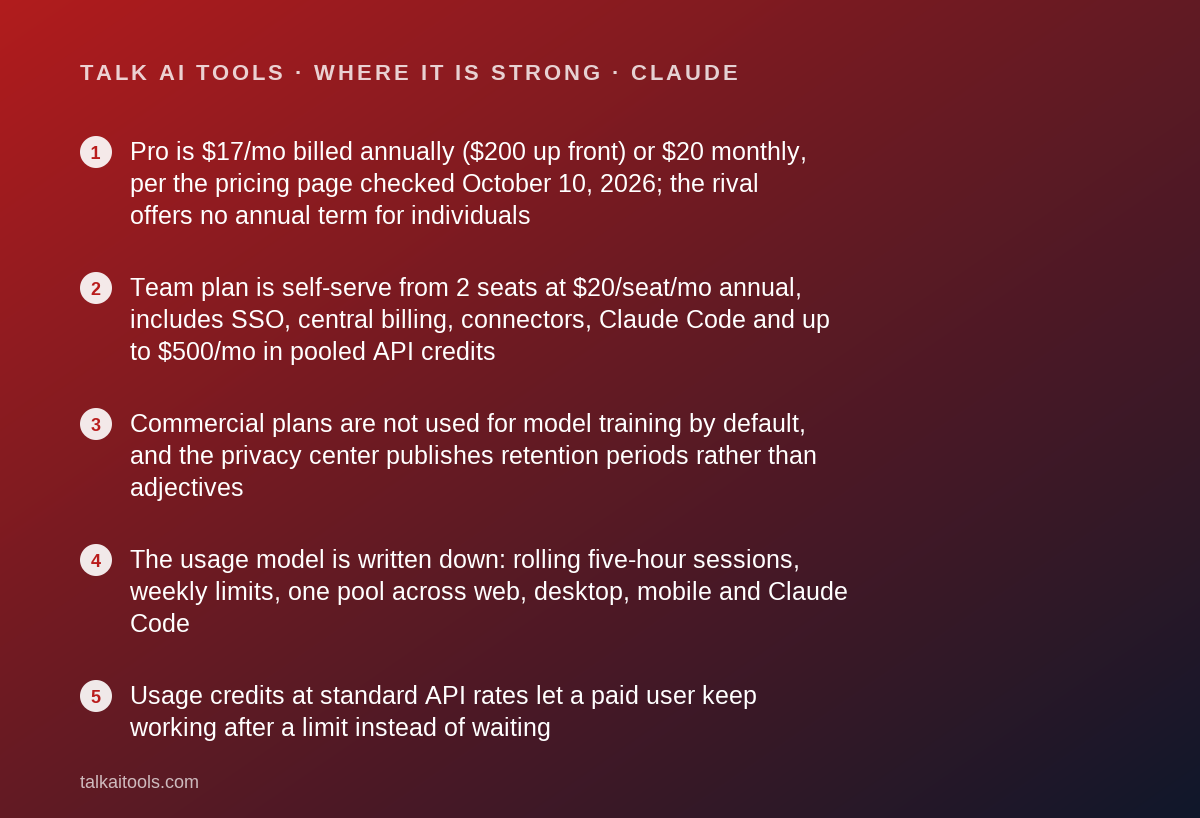
- Pro is $17/mo billed annually ($200 up front) or $20 monthly, per the pricing page checked October 10, 2026; the rival offers no annual term for individuals
- Team plan is self-serve from 2 seats at $20/seat/mo annual, includes SSO, central billing, connectors, Claude Code and up to $500/mo in pooled API credits
- Commercial plans are not used for model training by default, and the privacy center publishes retention periods rather than adjectives
- The usage model is written down: rolling five-hour sessions, weekly limits, one pool across web, desktop, mobile and Claude Code
- Usage credits at standard API rates let a paid user keep working after a limit instead of waiting
Where it falls short
- Free plan lists Sonnet and Haiku but not Opus, and does not include Claude Code; it is a trial of the product rather than a usable workspace
- Team plan lacks audit logs, SCIM, compliance API and custom retention, all Enterprise only per the comparison table
- No documented support channel for Team beyond the help center; customer success is listed only for sales-assisted Enterprise
- The help article and the pricing table disagree on whether Team includes role-based access; the table says No
- Team is credit card only with no invoicing; invoicing and net terms are listed only for sales-assisted Enterprise
At a glance
| Starting price | Free; Pro $17/mo annual or $20 monthly; Team $20/seat/mo annual or $25 monthly |
|---|---|
| Pricing note | Team from $20/seat/mo billed annually, $25 monthly, minimum 2 seats (pricing page and help center, checked October 10, 2026) |
| Free plan | Yes - everyday use with Sonnet and Haiku, web search, file creation, up to 5 projects; no Opus, no Claude Code |
| Seat minimum | Team: 2 members, up to 150 seats (help center); Enterprise above that |
| Annual billing | Pro and Team: monthly or annual; Max: monthly only; Enterprise: annual only |
| Training on your data | Consumer plans: opt-out in privacy settings. Team, Enterprise and API: not used by default |
| Context window | Up to 1M tokens on paid plans, varies by model (pricing page); Team help article cites 200K |
| Support channels | Help center; customer success support listed only for sales-assisted Enterprise at spend thresholds |
| Compliance | SSO and domain verification on Team; SCIM, audit logs, HIPAA-ready and custom retention on Enterprise |
What this subject page is, and is not
This is a documentation review. On October 10, 2026 we read Anthropic's pricing page, its Team, Enterprise and usage-limits help articles and three privacy center pages, and graded what they say. We did not run Claude for this page. The companion page on ChatGPT was built the same way the same day; the two meet in ChatGPT vs Claude.
What Claude actually is
Claude is Anthropic's assistant sold in two families. Individual plans (Free, Pro, Max) belong to one person. Organisation plans (Team, Enterprise) belong to a company and are billed per seat. All paid plans include Claude Code, a terminal tool, and Cowork, a desktop agent, and the pricing page says every surface draws from one usage pool.
The design choice that defines the product on paper is that Anthropic prices usage openly. Where a rival's page says limited, Claude's says five-hour session, weekly limit, 5x, 20x, 1.25x, 6.25x. Whether you like the numbers is a separate question from whether they are printed, and here they are printed.
Who Claude is best for
Read against the documentation, these are the buyers Claude fits:
- The sole trader who pays annually: Pro at $17 a month billed annually is the only individual annual term in this pair of reviews.
- A small team whose work is documents and code, since Claude Code, Cowork, projects and connectors to Google Drive, Gmail, Calendar, GitHub, Microsoft 365 and Slack are listed on Team.
- A company that must answer a client's data questionnaire, because the privacy center gives retention periods in days and years rather than assurances.
- A team that already spends on the Claude API, since the pricing page lists up to $500 a month in pooled API credits on Team.
- A manager who wants per-member limits, so one heavy user cannot exhaust the whole team's allowance; the Team article says limits are per member.
Who should skip it
Teams that mostly want unmetered everyday chat should look at the rival first; Claude's free plan is described as covering everyday questions, not as unlimited. Companies that need audit logs, SCIM, invoicing or custom retention without a sales conversation should know those are Enterprise features. And anyone expecting a human support channel on a $20 seat will not find one on the pages.
The case for the other side is made in full on the ChatGPT subject page.
What the free tier includes (as of October 2026)
The pricing page, checked October 10, 2026, lists the free plan at $0 with chat on web, desktop and mobile; web search; file creation and code execution; memory across conversations; connectors; Artifacts; and Claude Design, Slides and Docs. Projects are capped at five. The models are Sonnet and Haiku; Opus is not included, and neither is Claude Code.
Usage on Free resets on a rolling five-hour window, and the FAQ says Pro gives at least five times more usage per session than Free. No message count is published on any plan, which the page states directly.
The honest description is a sampler. It shows the product's shape and lets a person decide whether the shape fits before paying. It is not a workspace a company can run on, and the page does not pretend otherwise.
What sits behind the paywall
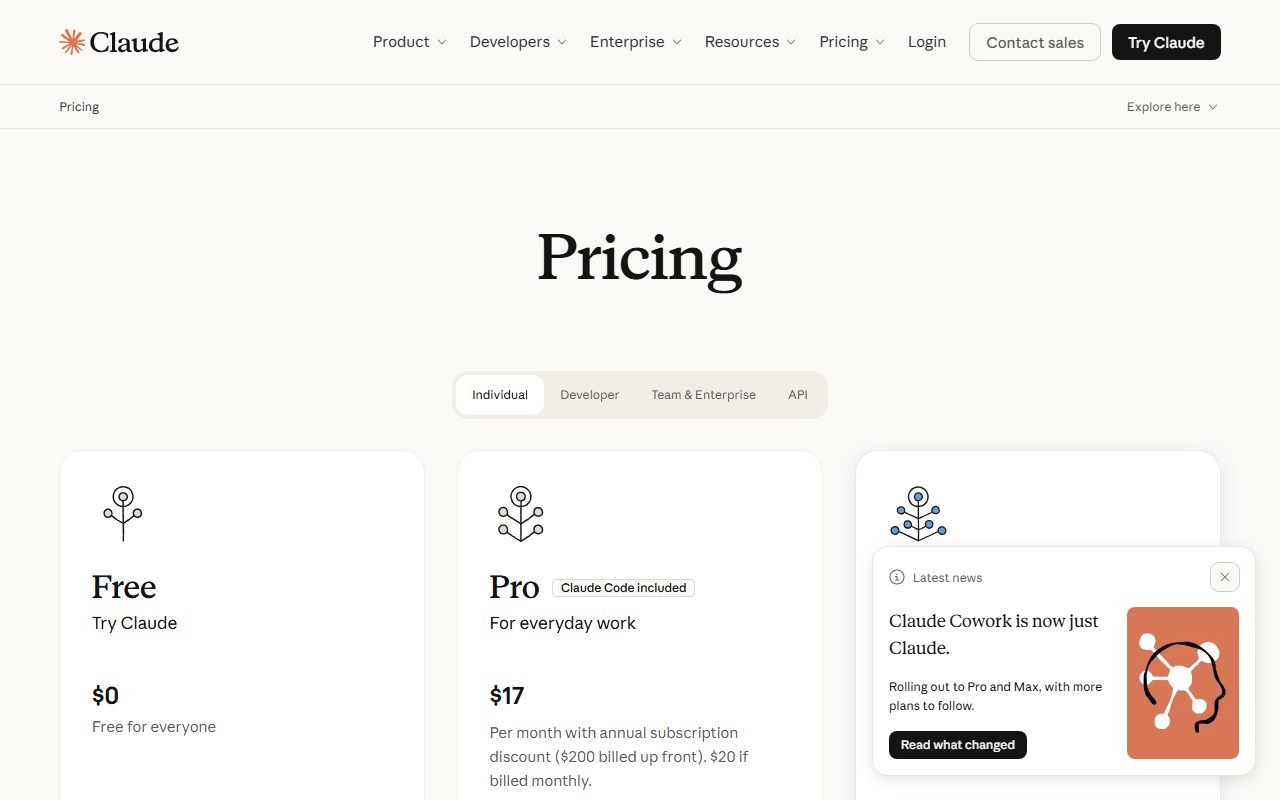
Pro is $17 a month with an annual subscription, billed as $200 up front, or $20 billed monthly. It adds more usage, more models including Opus, Claude Code, projects beyond five, scheduled and handed-off tasks, Claude Dashboards in beta, Claude Science, and Claude in Chrome and Microsoft 365. The comparison table lists context windows of up to 1M tokens varying by model.
Max starts at $100 a month for five times Pro usage, or $200 for twenty times, and is monthly only. Both tiers include a matching amount of monthly API credits, $100 or $200, plus higher output limits and priority access at busy times.
Fable, Anthropic's top model line, is listed as available on Max and on Team Premium seats at 50 per cent of weekly limits, and through usage credits on Pro. Opus, Sonnet and Haiku are listed on every paid plan.
How the pricing is structured for a company
Team is the plan a small company should compare. The Team help article, dated 2026, says plans require a minimum of two members and support up to 150 seats. Standard seats are $25 per member per month billed monthly or $20 billed annually. Premium seats are $125 monthly or $100 annually. Prices are for US customers and exclude tax.
The article quantifies the seats: Standard includes 1.25 times the Pro plan's per-session allowance; Premium includes 6.25 times. Both carry a weekly limit that resets at a fixed time assigned to the account. Limits are per member, so one person hitting a wall does not affect anyone else. The pricing page's shorter version is that Premium is five times Standard.
For ten people on Standard annual seats the arithmetic is 10 x $20 x 12, or $2,400 a year; on monthly billing it is $250 a month, or $3,000 a year. Two Premium annual seats in that ten lift the yearly figure to $4,320. These are editorial calculations from the listed prices, identical to the figures on the ChatGPT page because the seat prices are identical.
Included on Team per the pricing page: central billing, SSO, domain verification, admin controls for remote and local connectors, enterprise deployment of the desktop app, usage analytics, organisation-wide skills deployment, enterprise search, spend controls at organisation and user level, and up to $500 a month in pooled API credits. Billing is credit card only, monthly or annual, and seats can be added mid-term.
Enterprise is priced differently: $20 per seat per month billed annually for access only, with all usage billed at API rates, no included allowance, and admin-set spend caps. It adds SCIM, audit logs, compliance API, custom retention and a HIPAA-ready option.
The primer on AI assistant pricing sets both vendors' ladders side by side and explains which rungs a small team actually stands on.
Ease of use: what the 4.2 is built from
Three things support the score. The plan ladder is short: three individual plans and two organisation plans, with the Team plan self-serve on a card from two seats. The usage model is explained on the pricing page in plain sentences rather than footnotes. And Settings shows where a user stands against the limit, which the FAQ states.
It loses ground because the free plan withholds Claude Code and Opus, so a trial does not show the product a paying team would get. And because two of Anthropic's own documents disagree: the Team article lists role-based permissioning as included, while the pricing table marks role-based access as No on Team. We grade the table, as the more recent and specific source, and note the conflict.
Features: what the 4.3 is built from
The documented feature set is deep rather than wide. Projects with sharing, connectors to the common workplace tools, enterprise search across Slack and Microsoft 365, Research, Skills, memory, Artifacts, Design, Slides, Docs and Dashboards are all listed on Team. Claude Code and Cowork are included rather than sold separately, and the FAQ says they share the plan's usage pool.
The comparison table marks Claude in Chrome, Claude for Microsoft 365 and Outlook, voice mode, incognito chats and desktop extensions as Yes on Team. Context windows reach 1M tokens on the newest models, which matters for the long-document work this product is positioned for.
The score stops short of the rival's because the free plan is thinner, because there is no equivalent to an always-on consumer agent or scheduled public sites on the list, and because a documentation review can count features but cannot weigh them.
Value: what the 4.1 is built from
At the entry point the two vendors have converged: $20 a seat billed annually, $25 monthly, two-seat minimum. Claude's value score edges ahead on three documented items. Pro has an annual rate of $17, saving $40 a year against monthly. Max and Team include monthly API credits that can be spent elsewhere. And usage credits at API rates mean a limit is a meter rather than a wall.
It does not score higher because the free plan is a sampler, because Max is monthly only, and because the premium seat multiplier means the same thing here as on the rival's page: $20 is the floor for a light user and $100 is the price of a heavy one. We have argued elsewhere that this is the direction every seat price is heading; see What a seat means when the worker is software.
Support: what the 3.3 is built from
The pricing page's partnership table lists consultation, trials and customer success support at certain spend thresholds only for sales-assisted Enterprise. Team and self-serve Enterprise get the help center and in-product support. No response time, channel or hours are published for Team.
The help center is current and specific, with dated articles that answer billing and limit questions directly, which is why the score is not lower. But a small team paying $2,400 a year should know that the documents promise it no person to call, and we grade what the documents promise.
What users report
This page does not quote third-party review aggregators, whose averages pool developers, students and enterprises with the small teams this site writes for. When a later edition cites user reports, they will be named, dated and about the Team plan.
Limits stated by the vendor
The pricing page says every plan has usage limits that reset on a rolling five-hour session window, that paid plans add weekly limits, and that Anthropic may also limit usage through weekly and monthly caps or model and feature restrictions at its discretion. There is no fixed message count; usage depends on conversation length, model, features and effort level.
The usage-limits article adds that all surfaces count toward the same limit, and that when a limit is hit a paid user can wait, upgrade, or turn on usage credits at standard API rates. The Team article sets seat multipliers at 1.25x and 6.25x Pro, with weekly limits resetting at a fixed time per account.
These are more numbers than most vendors print, and they still do not tell you how many documents a seat will summarise in a week. Read Unlimited is a pricing word for why no vendor will.
Privacy and data use
For commercial plans the privacy center states that Anthropic will not use inputs or outputs from commercial products by default, with exceptions for feedback you submit or training you otherwise permit. Owners of Team and Enterprise organisations can turn off member feedback submission.
Retention is published with numbers. Chats in Claude for Work are kept while you keep them; a deleted conversation leaves history immediately and back-end storage within 30 days. Incognito chats are deleted within 30 days. Content flagged as a usage policy violation may be retained up to 2 years, and classifier scores up to 7 years. Feedback submissions are kept 5 years.
For consumer plans (Free, Pro, Max), training is governed by a privacy setting the user controls; the pricing table labels it opt-out. Raw content from connectors is excluded unless pasted into a chat.
The practical reading for a small company is the same as for the rival: personal accounts used for work are a policy gap, and the organisation plan is where the defaults become defensible. The essay Who reads what you type covers retention, permissions and the third model in the room.
Alternatives
ChatGPT. Choose ChatGPT if most of the team will use plain chat and you want it unmetered on the free plan, if you want the widest list of consumer features, or if you want workspace agents and scheduled team tasks on a $20 seat. Otherwise choose Claude if annual individual pricing, pooled API credits, per-member limits and published retention periods matter more.
The decision is argued section by section in ChatGPT vs Claude, and the other side is on the ChatGPT subject page.
Doing nothing. Letting staff use personal accounts is the most common alternative, and its cost is invisible until an offboarding or a client questionnaire. The general argument is in The tool is not the workflow.
Frequently asked
- Is Claude free to use? Yes: a $0 plan with chat, web search, file creation, memory and five projects on Sonnet and Haiku. No Opus, no Claude Code.
- How much for a team of 10? 10 x $20 x 12 is $2,400 a year on Standard annual seats, or $250 a month billed monthly (editorial calculation, October 10, 2026).
- Does Pro have an annual plan? Yes: $17 a month billed as $200 up front, or $20 monthly. Max is monthly only; Enterprise annual only.
- Does Anthropic train on what my team types? Not on Team, Enterprise or API by default. On Free, Pro and Max, a setting you can turn off governs it.
- What are the usage limits? A rolling five-hour session, weekly limits on paid plans, no fixed message count. Team Standard is 1.25x Pro per session, Premium 6.25x, per member.
- What does Team not include? Audit logs, SCIM, compliance API, custom retention, HIPAA-ready configuration, role-based access, ACH and invoicing; all Enterprise.
Bottom line
On its documentation Claude is the assistant to buy when you want to know what you are buying. The usage model is written down, the commercial data terms are off by default, the retention periods are numbers, and the individual annual rate is real. For a small team that lives in documents and code, the Team plan at $20 a seat is a fair price with the right defaults.
Budget for what the pages do not promise: a person to call, audit logs, invoicing, and a free plan that will not show you Claude Code before you pay. If those four are tolerable, the rest of the page says what it means. The same two-seat, $20 figure appears on the rival's page, which is why the comparison is decided on everything except price.
Sources, all checked October 10, 2026: claude.com/pricing; Claude help center articles on the Team plan, the Enterprise plan and usage limits; Anthropic privacy center articles on retention and model training.
Buy it if
- You will pay annually as an individual and want the $17 rate the pricing page lists for Pro.
- Your work is long documents and code: Claude Code and Cowork are included on every paid plan and share one usage pool.
- You want commercial data terms off by default and a retention page with numbers you can quote to a client.
- Pooled API credits would offset spending you already have; the Team plan lists up to $500 a month.
Skip it if
- You need audit logs, SCIM or invoicing without an Enterprise contract; Team does not list them.
- Most of the team will only use plain chat and you want it unmetered; the rival's free plan lists that and Claude's does not.
- You want a free plan that is a workspace; Claude's free plan is a sampler without Claude Code or Opus.
Frequently asked
Is Claude free to use?
Yes. The pricing page checked October 10, 2026 lists a $0 plan with chat on web, desktop and mobile, web search, file creation, code execution, memory and up to five projects. It uses Sonnet and Haiku, not Opus, and does not include Claude Code. Usage resets on a rolling five-hour window.
How much does Claude cost for a team of 10?
On Team Standard seats, 10 x $20 x 12 months is $2,400 a year billed annually, or 10 x $25 is $250 a month on monthly billing. That is an editorial calculation from the pricing page checked October 10, 2026. Premium seats at $100 or $125 raise it quickly.
Does Claude Pro have an annual plan?
Yes. The pricing page lists Pro at $17 per month with an annual subscription, billed as $200 up front, or $20 billed monthly. Team also offers annual terms; Max is monthly only and Enterprise is annual only.
Does Anthropic train on what my team types into Claude?
Not on commercial plans by default. The privacy center says Anthropic will not use inputs or outputs from commercial products (Team, Enterprise, API) unless you give feedback or otherwise permit it. On Free, Pro and Max, training is governed by a privacy setting you can turn off.
What are Claude's usage limits?
The pricing page says every plan has limits that reset on a rolling five-hour session, with weekly limits on paid plans and no fixed message count. The Team help article puts Standard seats at 1.25x Pro's per-session allowance and Premium at 6.25x, per member, not pooled.
What does the Team plan not include?
Per the comparison table checked October 10, 2026: audit logs, SCIM, compliance API, custom data retention, HIPAA-ready configuration, domain capture and role-based access are marked No on Team and Yes on Enterprise. Team also lacks ACH and invoicing.
Sources
- Claude pricing (plans, comparison tables, FAQ) - checked October 10, 2026
- What is the Team plan? (help center) - checked October 10, 2026
- What is the Enterprise plan? (help center) - checked October 10, 2026
- How do usage and length limits work? (help center) - checked October 10, 2026
- How long do you store my organization's data? (privacy center) - checked October 10, 2026
- Is my data used for model training? (privacy center, commercial) - checked October 10, 2026
- Is my data used for model training? (privacy center, consumer) - checked October 10, 2026
Update history
- October 10, 2026 - First edition, documentation review of pricing, help center and privacy pages.
Visit Claude
We have no affiliate relationship with this vendor. Link goes to the official site.