 Talk
TalkThe free tier is a research budget
The usual explanation of a free tier is marketing: give it away, build a habit, charge later. That story is true and incomplete, and on at least two pricing pages this month the missing half is printed in a table. One vendor's page has a row called "Used to improve our products" that reads Yes in the free column and No in the paid column. Another publishes a parallel price list for customers willing to share data, discounted by exactly half. We read four vendors' pricing and policy pages on October 14, 2026, and the free tier looks less like a gift than a line in a research budget.
Google prints the exchange rate as a table row
The Gemini API pricing page lists every model twice, once under Free Tier and once under Paid Tier. The last row of each block is labelled "Used to improve our products".
For Gemini 3.8 Flash, read October 14, 2026, that row reads "Yes" under Free Tier and "No" under Paid Tier. The input price in the same two columns reads "Free of charge" and "$0.75 through December 31, 2026". The pattern repeats across the Flash and Flash-Lite models on the page.
It is hard to state a bargain more plainly than that. Two columns, two prices, and the difference between them is a Yes and a No in the data-use row.
The flagship row completes the picture. Gemini 4 Argon carries the note "Gemini 4 Argon is not available on the Free tier or on the Google AI Pro plan", and every Free Tier cell for it reads "Not available", including the data-use row.
So the free tier exists on the cheaper models and is absent on the most capable one. We cannot read a motive off a table, and we will not pretend to. What the table does establish is that free access and data collection appear together on this page and separately nowhere on it.
OpenAI publishes a 50 per cent discount for sharing data
The clearest number of the four is in the fine-tuning section of OpenAI's API pricing page. Two rows describe the same model. One is "o4-mini-2025-04-16". The other is "o4-mini-2025-04-16 (data sharing)".
The first is listed at $4.00 per million input tokens, $1.00 cached and $16.00 output. The second is $2.00, $0.50 and $8.00. In the batch table the pair is $2.00 / $0.50 / $8.00 against $1.00 / $0.25 / $4.00.
Exactly half, in both tables. The footnote explains it: "Inference discounts are available if you enable data sharing when creating the fine-tune job."
That is a published exchange rate between money and data, denominated in dollars per million tokens. Anyone arguing about whether training data has value can now stop and read the table.
Paying does not always end the collection
The assumption that a paid plan buys you out is not safe.
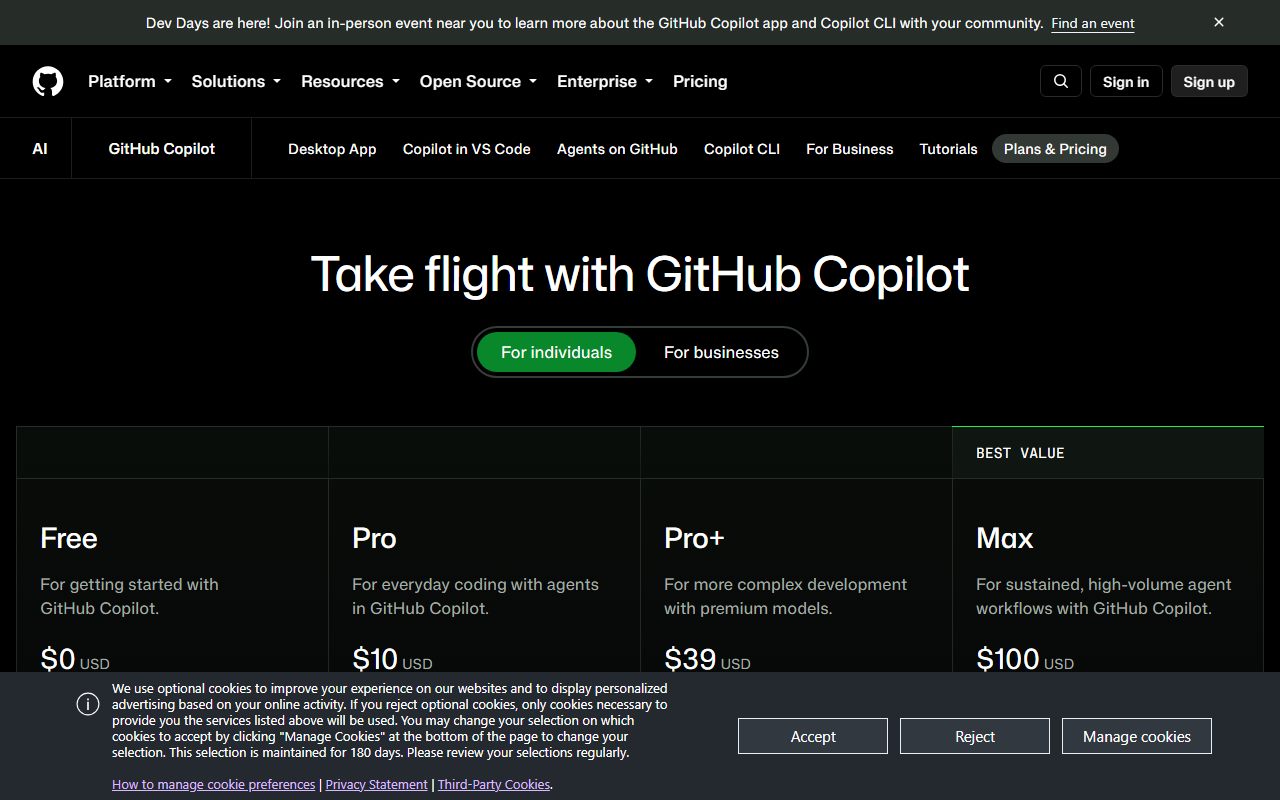
The GitHub Copilot plans page states that GitHub "may also use interactions from users with a Copilot Free, Copilot Pro, and Copilot Pro+ subscription - including inputs, outputs, code snippets, and associated context - to train and improve our AI models unless they have opted out".
Pro and Pro+ are paid plans. What ends the collection, on that page, is the opt-out in account settings rather than the invoice. The page adds that users were notified 30 days before the change took effect.
Anthropic's consumer privacy policy is built the same way: "We may use your Inputs and Outputs to train and improve Anthropic AI models, unless you opt out through your account settings."
The same policy lists the training sources, and users are one of them: "Data that our users or crowd workers provide, including Inputs and Outputs from our Services (unless users opt out)." Consumer conversations sit in the list beside web data, with the opt-out as the only separator.
Opt-out has carve-outs, and they are written down
The next sentence of that policy is the one worth copying into a note. Even after opting out, Anthropic states it will use Inputs and Outputs for model improvement when "your conversations are flagged for safety review" or when "you've explicitly reported the materials to us (for example via our feedback mechanisms)".
The second carve-out catches a reflex. Anthropic's consumer terms say that if you rate an output, "for example, by using the thumbs up/thumbs down icon", the related conversation is stored as Feedback, and "we may use the Feedback however we choose without any obligation or other payment to you".
A thumbs-down is therefore a donation, and a reasonable one: it is how the vendor learns what failed. It is still worth knowing that the gesture is a data event rather than a vote.
Where the real guarantee lives, it is a contract rather than a setting
The strongest promise we read on October 14, 2026 was not in a settings panel. It is a sentence in Anthropic's commercial terms of service: "Anthropic may not train models on Customer Content from Services."
That is a flat prohibition in a contract, not a toggle that a new employee might miss. On the subscription side, the Claude pricing page lists "No model training on your content by default" as a Team plan feature, where the operative words are "by default".
The same commercial terms show a second thing the paid tier buys. Anthropic agrees to defend customers against third-party intellectual property claims arising from "Customer's paid use of the Services". Paid use. The indemnity and the free tier do not overlap.
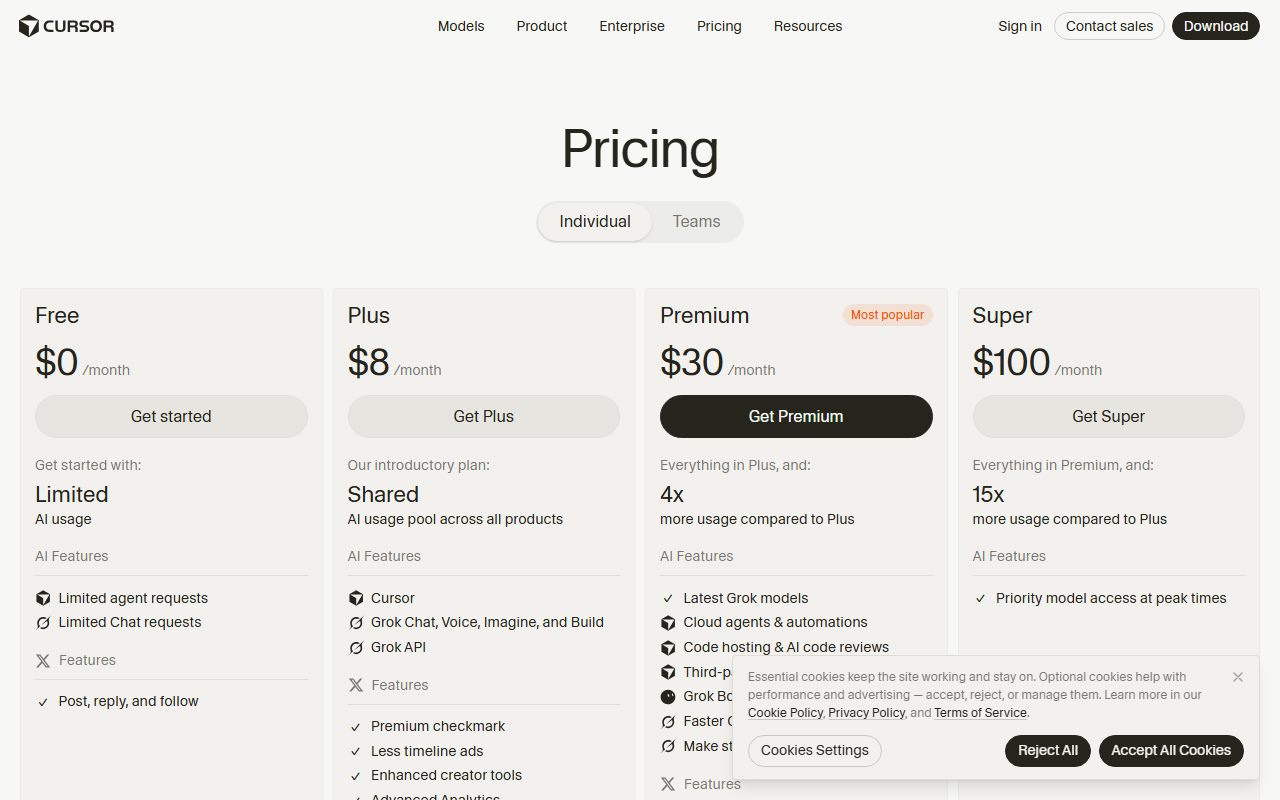
Cursor is the counterexample that keeps this from being a rule about free tiers in general. Its terms state in capitals that it "WILL NOT USE CONTENT TO TRAIN, OR ALLOW ANY THIRD PARTY TO TRAIN, ANY AI MODELS, UNLESS YOU'VE EXPLICITLY AGREED".
Its security page adds that Privacy Mode "is available to anyone (free or Pro)".
An opt-in default, available on the free plan, is a different arrangement from an opt-out default. Both exist in the same market in the same month.
What to do before the trial starts, not after
None of this argues against free tiers. It argues for pricing them properly, which means asking five questions while the signup page is still open:
- Is the data-use default opt-in or opt-out? Google's page answers it in a table row; Anthropic's and GitHub's answer it in prose. The default is the whole question.
- Does the paid plan change the default, or only the settings page? On the Copilot plans page the opt-out, not the invoice, is what stops training on Pro and Pro+.
- What survives the opt-out? Safety-flagged conversations and anything you explicitly report, per Anthropic's policy.
- Is the promise a setting or a clause? A commercial term saying the vendor "may not train" outlives a staff change. A checkbox does not.
- What else is tied to paying? Anthropic's intellectual property defence is scoped to paid use, so a free pilot that ships client work carries a risk the paid plan would have absorbed.
The second-order point is that a free pilot is not a free test of the paid product. If the free tier trains on your prompts and the paid tier does not, you are evaluating a different arrangement from the one you will buy.
Why calling it a research budget is fairer than calling it a trick
Training on willing users is how these products improve, and the vendors say so in the same sentence in which they ask. Google's row says "Used to improve our products". GitHub's text says the purpose is "more intelligent, context-aware coding assistance".
The transaction is legible and in several places priced. That is better behaviour than the adjective-heavy pages we examined in other contexts, and it deserves to be read as a deal rather than a betrayal.
What the word free obscures is only the direction of payment. The money moves one way; the data moves the other; and on OpenAI's page the two are now quoted in the same units. The question is not whether to accept the deal but whether the thing you are typing is yours to trade.
Which is where the older argument applies. Who reads what you type is about the second half of that question, and what a seat means when the worker is software is about who in the company makes the choice.
The token economics of the paid side sit in what a context window costs you, and the clock on the models themselves in when a model you built on is retired.
Plan-level detail, with the dates we read it, is in our subject pages for ChatGPT, Claude, Cursor and GitHub Copilot, the ChatGPT and Claude comparison and the primer on AI assistant pricing for small teams.
Sources, read October 14, 2026: ai.google.dev Gemini API pricing; platform.openai.com API pricing; github.com Copilot plans; anthropic.com privacy policy, consumer terms and commercial terms; cursor.com terms of service and security page.