 Talk
The indemnity with conditions attached
Four sets of terms were read against the live page markup on November 5, 2026. All four grant a defence against an intellectual property claim about an output. All four then withdraw it for outputs you modified, combined, or kept using after a warning.
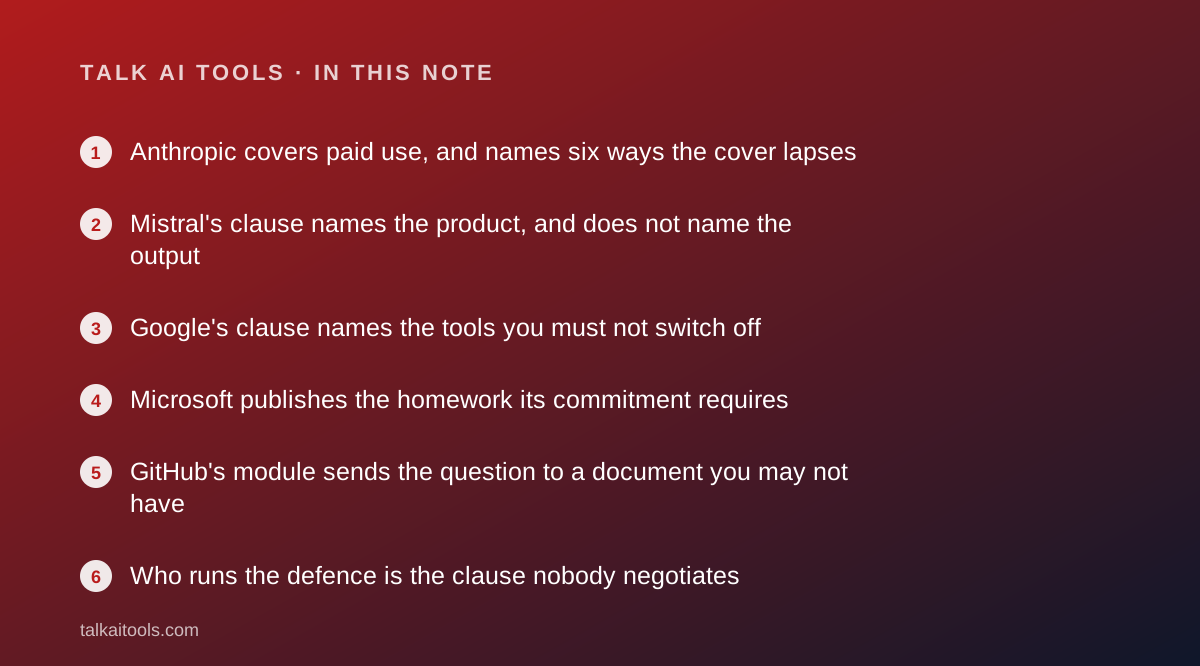
The promise is the headline. The exclusion list is the product, and it is where the differences between these vendors actually live.
Anthropic covers paid use, and names six ways the cover lapses
Anthropic's Commercial Terms, effective June 17, 2025, state the promise in one sentence. The company "will defend Customer and its personnel, successors, and assigns from and against any Customer Claim".
The definition of that claim carries the first condition. It covers an allegation that "Customer's paid use of the Services ... in accordance with these Terms or Outputs generated through such authorized use violates any third-party intellectual property right".
The word paid is doing work there. A free account is outside the sentence before any exclusion is reached, which matters for the way most small teams start.
Section K.3 then removes six situations from Anthropic's side of the bargain:
- Modified output. Modifications made by Customer to the Services or Outputs.
- Combined output. Combination of the Services or Outputs with technology or content not provided by Anthropic.
- Your own inputs. Inputs or other data provided by Customer.
- Knowing use. Use in a manner Customer knows or reasonably should know infringes the rights of others.
- Patents. The practice of a patented invention contained in an Output.
- Trademarks. An alleged trademark violation based on use of an Output in trade or commerce.
A seventh exclusion applies to both sides at once. Neither party owes a defence where the allegation arises from the indemnified party's "fraud, willful misconduct, violations of law, or breach of the Agreement".
Mistral's clause names the product, and does not name the output
Mistral's Commercial Terms of Service, effective September 25, 2026, promise a defence for the product itself. The clause reaches a claim "to the extent that the Mistral AI Products provided by Mistral AI to Customer under this Agreement infringe such third party's intellectual property rights".
The word output does not appear in that sentence. It appears in the exclusions, where modification "of the Mistral AI Products or Output by any party other than Mistral AI" is carved out.
Read together, an output claim is covered only as far as the product clause stretches. That is a narrower starting point than Anthropic's, which names Outputs in the promise itself.
The remaining exclusions are the familiar five: combination with other software or hardware, Customer Data, knowing use, breach of the terms, and failure to comply with applicable law.
Google's clause names the tools you must not switch off
Google's Cloud Service Specific Terms, last modified October 30, 2026, extend the indemnity to "an unmodified Generated Output from a Generative AI Indemnified Service using only Google Pre-Trained Model(s)".
Two words carry the conditions. Unmodified, and indemnified: the covered list is published on a separate page, and the definition excludes any service or feature "not provided to Customer free of charge".
The second carve-out is the one no other vendor here writes down. Cover lapses where the customer "disregards, disables, modifies, or circumvents source citations, filters, instructions, or other tools Google makes available".
A third carve-out ends the cover once you have been told. Using the output "after receiving notice of an infringement claim from the rightsholder or its authorized agent" puts the claim outside the promise.
Google also indemnifies separately for its own training data, and draws the line plainly. That second indemnity "does not cover allegations related to a specific Generated Output".
Microsoft publishes the homework its commitment requires
The Customer Copyright Commitment is the only one of the four with a public page of prerequisites. It describes Microsoft's obligation "to defend customers against certain third-party intellectual property claims relating to Output Content".
For configurable services the page lists two universal mitigations, both in force since December 1, 2023. One is a metaprompt "directing the model to prevent copyright infringement in its output".
The other is evidence. The offering must have been evaluated for reproduction of third-party content, and "the report of results and mitigations must be retained by the customer and provided to Microsoft in the event of a claim".
The page is explicit about who proves what. On a claim, "the customer will be required to demonstrate compliance with all relevant requirements". New mitigations arrive with a six-month window to implement them.
One requirement has since been withdrawn. For GitHub offerings, as of April 3, 2026 there are no additional required mitigations, and use of the Duplicate Detection filter "is no longer required for CCC coverage".
GitHub's module sends the question to a document you may not have
GitHub's Generative AI Services Terms, version March 2026, do not grant an indemnity at all. Section 4 points elsewhere: "If your Agreement provides for the defense of third party claims, that provision will apply to your use of Generative AI Services, including to Outputs."
Whether you hold such an Agreement depends on how you bought. That document applies only to volume licensing customers purchasing directly from GitHub.
Personal customers are sent to the Terms of Service instead, and anyone buying through Microsoft is sent to Microsoft's Product Terms. The same product, bought three ways, routes one question to three documents.
Who runs the defence is the clause nobody negotiates
An indemnity is a promise to pay and also a transfer of control. Anthropic's process clause gives the indemnifying party the right to control the defence, "including the selection of counsel, the strategy and course of any litigation or appeals".
Mistral's procedure clause is shorter and lands in the same place. The indemnifying party must be "granted the exclusive right to control and direct (including the authority to select legal counsel)" the defence.
One protection survives for the party being defended. Anthropic's clause lets it reject a settlement that "requires that it admit wrongdoing or liability or subjects it to an ongoing affirmative obligation".
Both clauses require prompt written notice and cooperation. A notice sent late is itself a way to lose cover you were counting on.
Five lines to find before you rely on an indemnity
- Does the promise name Outputs? Anthropic's does. Mistral's names the Products.
- Is it paid only? Anthropic says paid use; Google's definition excludes free-of-charge services.
- Is modification excluded? In all four documents, yes, and that covers most editing.
- Is there a prerequisites page? Microsoft publishes one and asks for your evaluation report on a claim.
- Who picks the lawyer? The vendor, in both clauses here that address it.
What follows in practice
An output indemnity is worth having and is not a reason to stop reading. The exclusions describe ordinary production work: editing the output, pasting it beside code you already owned, shipping it under your own name.
The cheap response is to leave the citation and filter tools switched on, and to write down that you did. Two of these four vendors make that record a condition of the cover.
Our subject pages for the two vendors quoted most here are Claude and GitHub Copilot, with plan figures in our primer on AI assistant pricing for small teams.
The neighbouring question, who pays when an output is simply wrong rather than infringing, is in who answers when the model is wrong.
What you owned in the first place is in who owns what the model writes, and the training default underneath it is in the default that trains on your work.
Agent runs raise the same question with a wider blast radius, which is the subject of when the assistant opens a pull request, and free usage sits outside two of these clauses entirely, as in the free tier is a research budget.
The editor shortlist for these tools is in the best AI coding assistants for small teams.
An indemnity is a statement about who the vendor expects to be careful. On this reading all four answer the same way, and the answer is you.
Sources
- Anthropic Commercial Terms of Service, effective June 17, 2025 (Section K: K.1 Claims Against Customer and the definition of Customer Claim covering paid use and Outputs, K.3 Exclusions (a) to (f) plus the shared fraud and breach exclusion, K.4 Process and control of the defence) - checked November 5, 2026
- Mistral AI Commercial Terms of Service, effective September 25, 2026 (Section 8: 8.1 indemnity for infringement by the Mistral AI Products, 8.2 Exclusions (a) to (f) including modification of Products or Output, 8.4 Procedure and exclusive right to control the defence) - checked November 5, 2026
- Google Cloud Service Specific Terms, last modified October 30, 2026 (Additional Google Indemnification Obligations: unmodified Generated Output from a Generative AI Indemnified Service, the four carve-outs including disabling source citations or filters and use after notice from a rightsholder, the separate training data indemnity, and the definition excluding free-of-charge services) - checked November 5, 2026
- Microsoft Customer Copyright Commitment Required Mitigations (the CCC as an obligation to defend customers over Output Content, the two universal required mitigations effective December 1, 2023, the retained evaluation report provided on a claim, the six-month window for new mitigations, and the April 3, 2026 note that Duplicate Detection is no longer required for GitHub offerings) - checked November 5, 2026
- GitHub Generative AI Services Terms, version March 2026 (Section 1 applicability for volume licensing, personal and Microsoft customers; Section 4 Defense of Third Party Claims deferring to the main Agreement) - checked November 5, 2026