 Talk
When support is a plan feature
Support looks like a service and is sold as a feature. It appears on the comparison grid between single sign-on and audit logs, and like them it switches on at a particular price. Three vendors publish the detail.
All three were read against their live documentation on October 24, 2026. What the tier buys, in order of how often it surprises people: the right to ask, the speed of the first reply, the hours, the language and the scope.
The first thing a tier buys is permission to ask
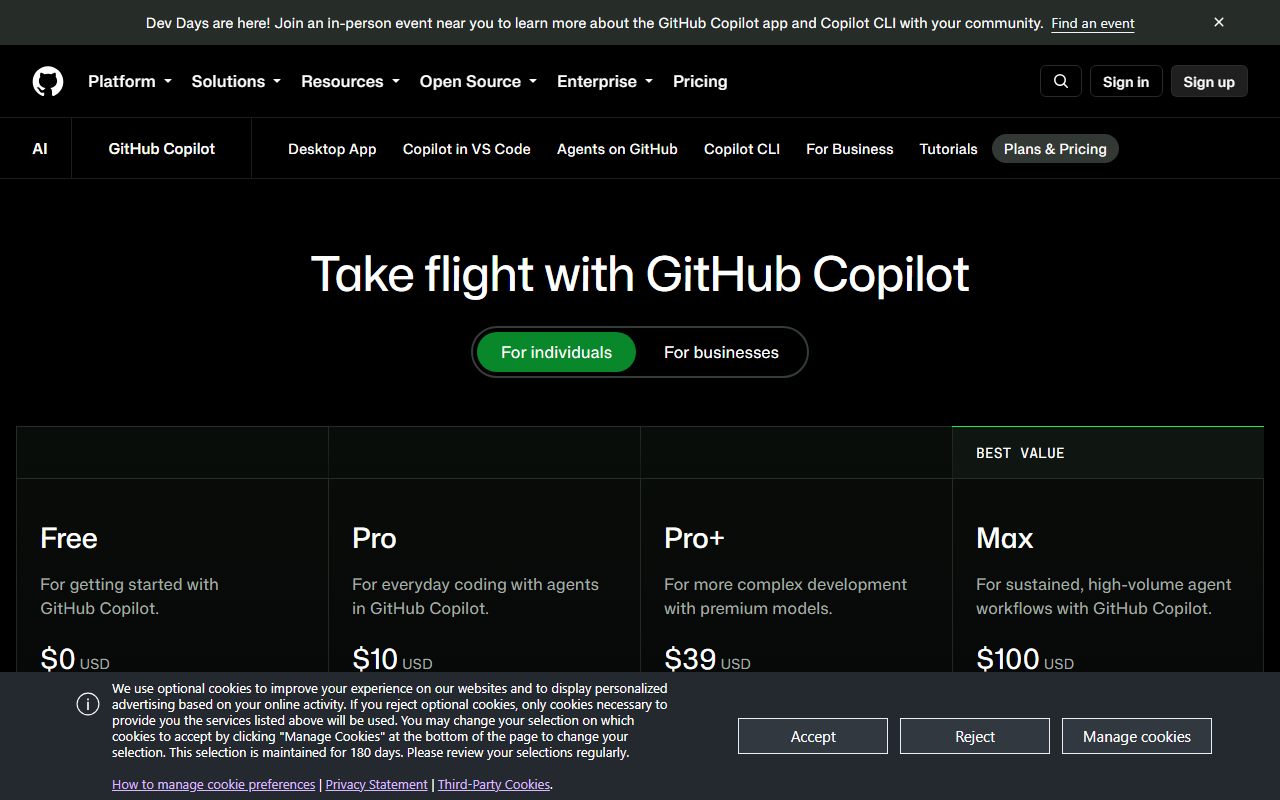
GitHub's support documentation opens with a plan matrix rather than a promise. GitHub Free gets Community Support only; Pro and Team add Standard support; Enterprise Cloud and Enterprise Server get Enterprise support.
The Free row is explicit about the narrow exception. Free users "can contact GitHub Support to report account, security, and abuse issues", and otherwise belong in the community discussions.
Atlassian states the same boundary in one line. "Support offerings are bundled with Standard, Premium, and Enterprise plans. The Free plans have access to self help resources."
Then it narrows the right further, by role. Support entitlements on the Standard tier belong to "Product and site admins of Standard product sites"; Premium and Enterprise add organisation admins.
GitHub puts a number on the same idea. Its Premium Support documentation lists "Members with support entitlements" as 20 on the Premium plan and 40 on Premium Plus.
This is the quiet part of a support purchase. The engineer who met the bug is often not the person allowed to describe it, so the ticket is written at second hand.
A response time is an initial response, and the clock is theirs
GitHub sells Premium Support as "A Service Level Agreement (SLA) with guaranteed initial response times" and publishes the table: 30 minutes for Urgent, 4 hours for High, 24 hours for Normal, 48 hours for Low.
Two sentences on the same page define the promise more honestly than the word guaranteed suggests. "Response time begins when GitHub Premium Support sets the priority level of the ticket."
And: "A response does not mean the issue has been resolved." The thirty minutes buys an acknowledgement, an assignment and a request for logs.
Callback requests sit outside the commitment altogether. They "are not tied to SLAs; a Support Engineer or representative will respond as soon as possible based on ticket priority and availability".
Atlassian publishes a four-level table per plan and chooses weaker language for it. "Atlassian will use commercially reasonable efforts to meet the target initial response time for the applicable severity level."
Its ladder for a level one incident, meaning application down, runs 2 business hours on Standard, 1 hour on Premium and 30 minutes on Enterprise. The Enterprise tier also commits to 2 hours at L2, 8 hours at L3 and 24 hours at L4.
Google Cloud Customer Care shows what the bottom of such a ladder looks like when a tier simply has no entry. Standard Support publishes 4 hours for P2 and 8 hours for P3 and P4.
There is no P1 row on Standard at all. The first priority level appears on Enhanced Support, at 1 hour, and on Premium Support, at 15 minutes.
An absent row is a harder fact than a slow one. On the cheapest paid tier, the category reserved for a production outage has no published target.
Support is priced as a percentage of what you already spend
The Google Cloud pricing structure is the clearest published example of support as a metered product rather than a plan inclusion.
Standard Support is a "Minimum spend of $29.00" or "3% of monthly Cloud charges", whichever is higher. Enhanced Support starts at a $100 minimum and runs on a sliding scale.
That scale is published in bands: "10% of monthly Cloud charges for the first $0 - $10K", then 7 per cent from $10K to $80K, 5 per cent from $80K to $250K and 3 per cent above that.
Premium Support carries a "Minimum spend of $15,000.00" a month, which is $180,000 a year before any percentage applies, by our arithmetic from the published minimum.
GitHub prices its own supplement the same way without publishing the rate. "If you are a licensed billing customer, the support fee percentage is applied to the cost of licenses for the current year."
For metered customers the fee is "either a percentage of your estimated metered spending or a set minimum annual fee, whichever amount is higher", estimated from the previous twelve months.
Read that alongside a usage-billed assistant and the shape becomes clear. Spending more on the product raises the price of being able to ask about it.
Hours and languages are separate numbers
A response target is only meaningful inside the hours it applies to, and the hours move by tier too.
Google Cloud: Standard Support gives "8/5 response for high-impact issues", while Enhanced and Premium both give "24/7 response for high- and critical-impact issues".
Atlassian: Standard is 9 hours per day Monday to Friday, Premium is 24/7 for L1 and 24/5 for L2, and Enterprise is 24/7. Phone support is marked not available on Standard.
Atlassian also defines the weekend, which matters because weekend coverage is itself a tier feature. "Weekends start from 5PM US Pacific timezone until Monday 10AM Australian Eastern timezone, spanning a total of 48 hours."
Language is the least discussed row and the most consequential outside the United States. Google Cloud lists English for Standard Support, and "English, Japanese, Mandarin Chinese, Korean and French" for Enhanced and Premium.
GitHub takes the opposite approach and states it rather than selling it. "You can contact GitHub Support in English," with translation of comments into six languages but English expected in replies.
Scope removes some questions at every tier
The scope list is where a support contract declines work, and it applies equally to Premium customers. GitHub's exclusions name the areas most likely to generate a ticket about an assistant.
"Preview features. Public preview, private preview, and technical preview features are out of GitHub Support's scope." So is anything about the suggestions themselves: "GitHub Copilot suggestions."
The billing exclusion is the one to read twice. "GitHub Support does not audit or break down Copilot usage consumption," and "cannot determine why usage appears high or why included usage was exhausted sooner than expected".
That is the single most common question a team has about a metered assistant, and it is answered on the scope page rather than in a ticket.
The documentation adds a date that belongs in any evaluation. "The terms of GitHub Premium Support are subject to change without notice and are effective as of November 2021."
Five rows that define a support tier
- Who may open a ticket. Admins only at Atlassian's Standard tier; 20 or 40 entitled members at GitHub's two Premium plans.
- What the first response is. An acknowledgement and an assignment, on a clock that starts when the vendor sets the priority.
- Whether your worst case has a row. Google Cloud's Standard Support publishes no P1 target.
- Which hours and which language. 8/5 against 24/7, English only against five languages, with weekends defined in the footnotes.
- What is excluded for everyone. Preview features, model output quality and consumption analysis, across tiers.
What follows in practice
Before buying a tier for its response time, check that your likely incident has a published row, falls inside the covered hours and is not named in the scope exclusions. Otherwise the number is not for you.
Then budget support as a percentage rather than a line item, because on at least two of these vendors that is literally how it is charged.
The habit of mistaking a tool's promises for the work it has to fit into is the subject of the tool is not the workflow, and the usage questions support will decline are examined in what a rate limit is rationing.
Benchmark numbers get the same treatment in a benchmark is not a brief: a published figure is only as useful as the definition printed beside it.
Plan and price detail sits in our primer on AI assistant pricing for small teams and our shortlist in best AI coding assistants for small teams.
Subject pages for two of the products whose support terms are quoted or implicated here: GitHub Copilot and Kiro.
A support tier is not a promise to fix your problem. It is a priced description of how quickly somebody will confirm they have read it, and a list of problems they will not take.
Sources, read against the live page markup on October 24, 2026: docs.github.com About GitHub Support and About GitHub Premium Support; confluence.atlassian.com Atlassian Support Offerings; cloud.google.com Customer Care.
Sources
- About GitHub Support, GitHub Docs (plan matrix for Community, Standard, Enterprise and Premium support; English-only tickets; scope exclusions) - checked October 24, 2026
- About GitHub Premium Support, GitHub Docs (30 minute Urgent initial response, clock starts at priority assignment, callbacks outside the SLA, 20 and 40 support entitlements, fee as a percentage of spend) - checked October 24, 2026
- Atlassian Support Offerings (support bundled with Standard, Premium and Enterprise; L1 targets of 2 business hours, 1 hour and 30 minutes; commercially reasonable efforts; weekend definition) - checked October 24, 2026
- Google Cloud Customer Care (no P1 row on Standard Support; Enhanced 1 hour and Premium 15 minutes for P1; minimum spends of $29, $100 and $15,000; support languages by tier) - checked October 24, 2026