 Talk
The annual plan billed monthly

On a pricing page the word monthly can describe two different things: how often you pay, and how long you are committed. Three vendors publish the distinction, and only one of them puts it in the heading.
All three pages were read against their live markup on October 25, 2026. The question is simple and expensive. If you stop in month four, do you owe nothing, one month, or the rest of the year?
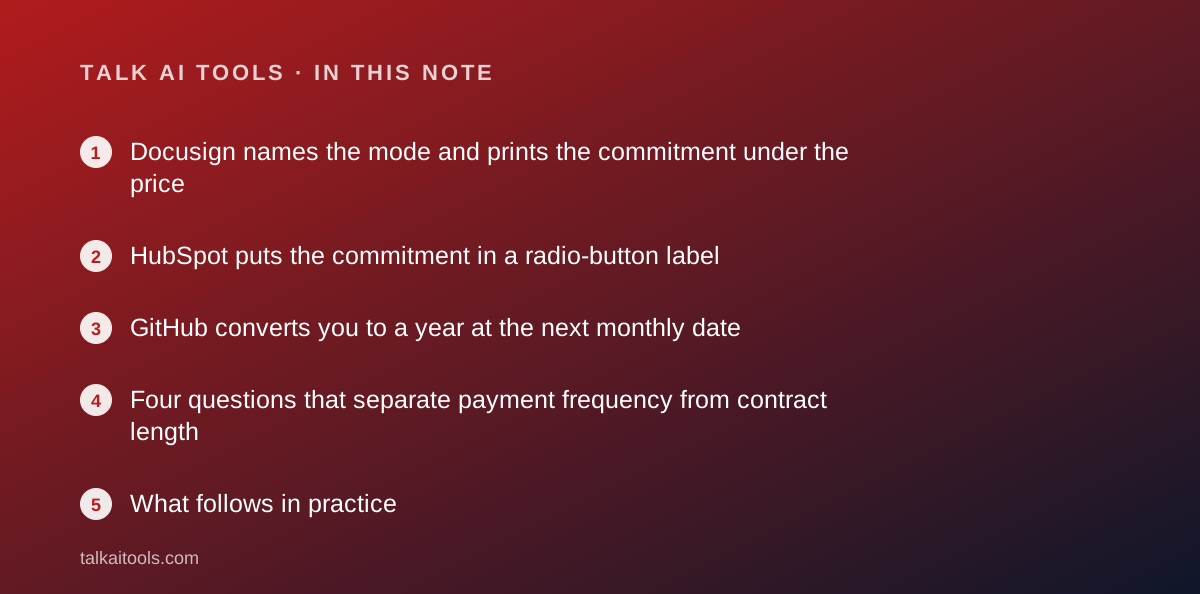
Docusign names the mode and prints the commitment under the price
Docusign's pricing page ships with a subscription type already selected, and the label is unusually honest. The selector reads "Annual | Billed monthly", and it is the default view of the page.
The price shown is monthly and the footnote is annual. The Personal plan reads "$11" per month, with the line "This is an annual commitment of $132" directly beneath the button.
The same pattern repeats down the row. Standard is "$30" per user per month with "an annual commitment of $360", and Business Pro is "$45" with "an annual commitment of $540".
All three multiply cleanly by twelve, which is the check worth running on any page that shows a monthly figure beside an annual total. By our arithmetic the commitments are exactly twelve times the displayed price.
The page also answers the question in its own words. Its help section asks "What is Annual | Billed monthly?" and explains that "you enroll in a full year of service but pay your subscription in monthly installments".
The exit terms are published in the same answer. "You may cancel within 30 days of purchase without penalty by selecting Cancel Subscription in your Account Settings."
After that window, the sentence changes shape. "If you cancel after the 30-day period, you'll be required to pay the remaining balance on your annual subscription, including any taxes or overage costs."
The contrast with a true month-to-month plan is stated too. "For monthly subscription plans, you can cancel your account at any time and you will not be charged for the next month."
Three subscription types appear in the page's own markup: "Monthly", "Annual | Billed monthly" and "Annual | Billed upfront". The middle one is the default, and it is the one that looks like a monthly plan on the card.
The discount ladder is published as tooltips rather than a table. The annual-billed-monthly mode is marked "You're saving up to 25%" and paying annually up front is marked "You're saving up to 44%".
Read that as a price for liquidity. A quarter off for a year of commitment paid in instalments, and nearly half off for the same year paid in advance.
HubSpot puts the commitment in a radio-button label
HubSpot's Marketing Hub page offers a "Billing period" control, and the wording of its two options is where the term hides.
On the Professional card, the monthly option is labelled "Pay Monthly" with the sublabel "Commit annually". The annual option is labelled "Pay Annually" and carries the "Best Value" tag, and it is the one selected by default.
On the Starter card the same control reads differently. There the monthly option is labelled "Pay Monthly" with the sublabel "Commit monthly".
That one-word difference between cards is the whole finding. Paying by the month on Starter leaves you free; paying by the month on Professional does not.
The prices on the Professional card, as rendered with the annual option selected, read "$800" per month with "$890" per month struck through, and "Includes 3 Core Seats" with additional core seats from "$45" per month.
One footnote belongs in the same arithmetic and sits outside the billing period entirely. "Cost shown does not include the required, one-time Professional Onboarding for a fee of $3,000."
A required one-time fee is not a discount question. It is a floor under the first year, and it survives whichever billing period you choose.
GitHub converts you to a year at the next monthly date
GitHub's Terms of Service, effective April 27, 2026, describe the switch rather than a plan. "If you change from a monthly billing plan to a yearly billing plan, GitHub will bill you for a full year at the next monthly billing date."
The refund position is stated in the same section and leaves no room for proration. Service is "billed in advance on a monthly or yearly basis respectively and is non-refundable".
The list that follows is specific. There are "no refunds or credits for partial months of service, downgrade refunds, or refunds for months unused with an open Account", though service runs to the end of the paid period.
And the policy is declared uniform. "In order to treat everyone equally, no exceptions will be made."
For a small team the practical reading is about timing rather than price. An upgrade taken in a busy week can pull a full year forward to the next billing date.
Four questions that separate payment frequency from contract length
- What is the commitment, in money? Docusign prints it: $132, $360, $540 for the three e-signature plans.
- What does the monthly option commit you to? "Commit annually" on HubSpot's Professional card, "Commit monthly" on Starter.
- What happens if you stop in month four? Docusign: the remaining balance, after a 30-day window.
- What does an upgrade trigger? At GitHub, a full year billed at the next monthly date, non-refundable.
What follows in practice
Screenshot the card with the billing period you intend to buy, including the footnote. Two of these three pages change their displayed price when the control moves, and the default is not always the cheapest mode.
Then multiply the monthly figure by twelve and look for that number on the page. If it appears, you are reading an annual commitment. If it does not, ask support in writing which mode the checkout will create.
Finally, treat any cancellation window as a diary entry rather than a reassurance. Thirty days is enough to test a workflow and not enough to test a quarter.
The unit being committed to is its own puzzle once software does the work, as argued in what a seat means when the worker is software.
Pricing words that describe the vendor rather than the product are examined in unlimited is a pricing word, and free allowances in the free tier is a research budget.
Money that comes back as credit rather than cash is the subject of an SLA credit is not a refund, and the same instinct applies to a commitment paid in instalments.
Plan structure for assistants sits in our primer on AI assistant pricing for small teams. Two subject pages where billing mode decides the comparison: ChatGPT and Cursor versus GitHub Copilot.
A monthly price is a payment schedule. Whether it is also a monthly contract is a separate fact, published in a tooltip, a radio-button sublabel, or a sentence about what happens at the next billing date.
Sources, read against the live page markup on October 25, 2026: Docusign products and pricing, including its embedded help text and subscription type labels; HubSpot Marketing Hub pricing; GitHub Terms of Service, effective April 27, 2026.
Sources
- Docusign Pricing, eSignature plans (default subscription type Annual | Billed monthly; $11, $30 and $45 per month with annual commitments of $132, $360 and $540; 30-day cancellation then remaining balance; Monthly and Annual | Billed upfront modes; savings tooltips of 25 and 44 per cent) - checked October 25, 2026
- HubSpot Marketing Hub pricing (billing period options labelled Pay Monthly / Commit annually on Professional and Pay Monthly / Commit monthly on Starter; $800 per month with $890 struck through; required one-time Professional Onboarding fee of $3,000) - checked October 25, 2026
- GitHub Terms of Service, Section L Payment (monthly to yearly switch billed for a full year at the next monthly billing date; non-refundable; no credits for partial months or unused months) - checked October 25, 2026